How to Make Safe and Healthy Reed Diffusers with Essential Oils


Essential oil reed diffuser

I like my home to be filled with pleasing aromas, but I’m wary of the ingredients in air fresheners, scented candles and other common items people use to mask odors in their homes. So, I was excited to come across an easy way to make homemade reed diffusers from pure essential oils! All you need is mineral oil, vodka, the essential oil (or oils) of your choice, a small vase, and some diffuser reeds, which you can buy in any craft store.

Here’s what you do:

Pour ¼ cup mineral oil and 2-3 tablespoons of vodka into the vase. Then add a 15-ml bottle of essential oil (or a total of 15 ml of the the oils you decide to blend). I chose geranium and lemongrass in mine.

Stir everything with the reeds and then let it go to work. It’s that easy! You can flip the reeds every once in a while to diffuse the oil better.

The fragrance you’ll enjoy will not comprise your health! In fact, it will probably improve it since essential oils have so many wonderful properties and benefits.

Want Better Sleep? Here’s Help!


sleep remedies

I’m finding more and more information about the relationship between sleep and overall health. According to experts on the subject, people who sleep well live longer, live better, and have fewer chronic diseases.

So what do you do if, like me, you find yourself wide awake at 3 am more often than you’d like?

Get on a schedule

The general consensus is you should go to sleep at the same time each night and wake up at the same time in the morning (including your days off). Sleep experts seem to agree that 10 pm is the sleep “sweet spot.” Apparently, that’s because our bodies produce melatonin between 10 pm and 2 am, and we need melatonin to relax and get to sleep. Most of us need seven or eight hours of quality sleep each night.

Go into sleep mode

If you’re involved in some kind of stimulating activity just before 10 pm, chances are slim you’ll be sleeping during those prime melatonin-producing hours. So instead of watching TV, having a heated debate with a family member, or getting some work (or homework) done after 9 pm, try something relaxing instead. Doing a bit of restorative yoga, listening to calming music, and meditating are good things to try.

Sleep in the dark

This may seem obvious, but many of us do not do it. In order for your body to create melatonin, you need to sleep in as near to pitch black darkness as possible. That means the light from streetlights streaming through windows, glowing clocks, cell phones and nightlights or a television kept on while you’re trying to get to sleep no-nos.

And it’s not just while you’re trying to fall asleep that you’ll need darkness if you want to sleep well. You’ll need it for at least two hours before you fall asleep.

Of course, if you’re like most people, turning the TV or computer off before bed is not going to happen every night. But it turns out if you’re stubborn about flipping the TV off early, there are a couple of ways around it.

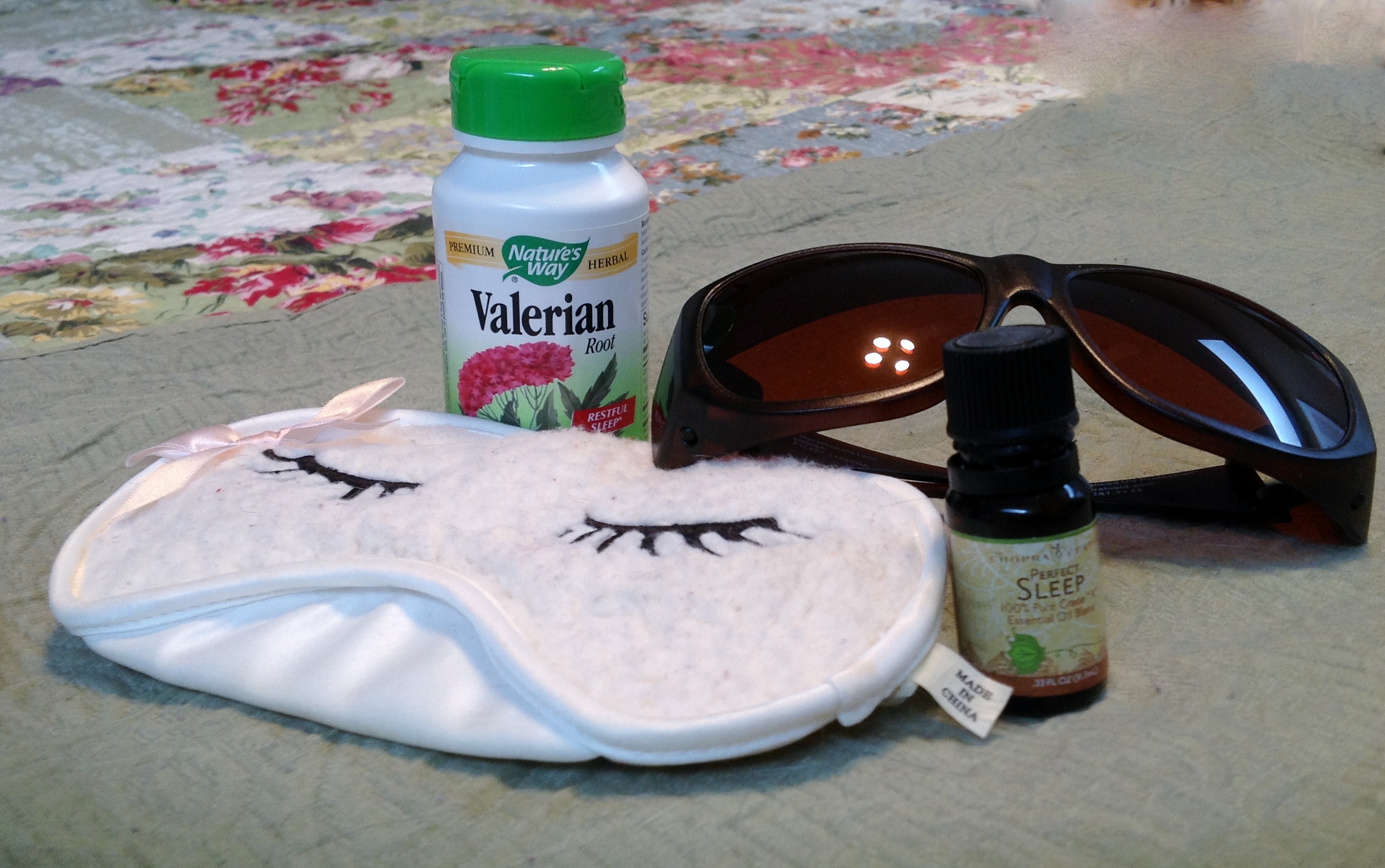
If you’re going to watch TV or surf  the net at night, wear sunglasses while you do it.  I learned this seemingly odd tip from the Dr. Oz Show, tried it the next night, and to my pleasant surprise it actually did help! According to Dr. Oz, the sunglass remedy works because certain dark lenses block out the blue light that prevents the body from producing melatonin.

Wear a sleep mask. (It’s a lot more comfortable than trying to sleep with your sunglasses on.) This may be the single best thing I ever added to my sleep routine. Credit for this tip goes to my brother!

Get help from herbs

Herbs like chamomile and valerian root can also help improve sleep. You can take them in capsule form or drink a cup of tea containing calming herbal ingredients before you go to bed. (If you drink tea, brew it well and drink only a few ounces so you won’t wake up to go to the bathroom!) When I’m feeling sleep deprived or worried I’m going to have a restless night, I take valerian root capsules to help me stay relaxed.

Try aromatherapy

Aromatherapy works wonders for sleep-challenged folks. This simple practice is my favorite trick for getting a better night’s sleep. I’m in awe of the tools nature has provided in the essential oils of plants.

Science has shown the aromas from essential oils have many remarkable properties. Oils that can calm the mind, relax the body, and promote sleep include lavender and ylang ylang, as well as blends created just for sleep.

You can use aromatherapy oils in a diffuser that fills your bedroom with the scent through the night, or, if you don’t have a diffuser, simply dab some oil on a piece of cotton or even inside the rim of your lower nostrils.

Sweet dreams!

I’ve tried all these remedies, and they work for me most of the time (which is great, considering at one point I was lucky if I slept through the night once a week).

If you have trouble sleeping and these or other natural solutions don’t work for you, it might be worth visiting your doctor to see if you have a more serious sleep disorder.

Valerian Root: The Sleepy Time Herb


I write a lot about herbal supplements, mostly for clients. Obviously I can’t try every supplement I write about, but one I have used myself is Valerian root. I use it for sleep, but I’m told it’s also good for stress and anxiety.

What is Valerian Root?

Valerian is a perennial plant that has a long history of use as an herbal remedy. Ancient Greeks used it to treat digestive problems. Valerian has also been used for centuries as a nervous system tonic and a sleep aid.

The active ingredients in Valerian root are valerenic acid and isovaleric acid, which is produced as the plant ages. Both compounds are volatile oils said to work by relaxing the central nervous system and promoting sleep. Double blind studies suggest Valerian root may decrease the amount of time it takes for people with mild insomnia to fall asleep.

Valerian root is a sedative, so it is also used to treat anxiety and stress. Some people find it helpful for muscle aches and tension headaches because it acts as a muscle relaxant.

Valerian Root Side Effects and Dosage

Valerian root has few side effects. It doesn’t cause the grogginess you might get from a prescription sleep aid or even some over the counter remedies. You can take it in capsules, tablets, tinctures or liquid extracts.

The maximum recommended intake of Valerian is 15 grams of plant material, which is usually about 15 to 20 drops of tincture several times daily or 450 to 500 mg of concentrated, standardized extract. Standardized extracts should contain between .5 % and 1% volatile oils.

You can also make Valerian tea by steeping 1 teaspoon of the dried root in a cup of hot water for ten minutes. There are time-release formulas of Valerian you can use for a sustained feeling of relaxation throughout the day. If you take Valerian for sleep, take it an hour or so before bedtime.

Of course, you should use this herb conservatively. If you have serious anxiety or insomnia, you may need to talk to your doctor, especially if you’re already on any kind of prescription medication.

Why I’ve Supported Farm Sanctuary’s Walk for Farm Animals (And Hope You’ll Support the Sanctuary Too)

In past years, Farm Sanctuary held its Walk for Farm Animals in cities across the country in October. This year, there was only one walk. It took place in Chicago on October 1, 2016.

The Walk for Farm Animals events raise funds for the sanctuary, which cares for farm animals and educates people about the abuses they suffer at the hands of mass food manufacturers. In 2017, the sanctuary will launch a new fundraising event.

Why I’ve supported Farm Sanctuary’s Walk for Farm Animals

When I first moved toward a vegetarian diet decades ago, I found an article called “Why I Am a Vegetarian.” I typed up a list of bullet points from the article to carry in my wallet so I’d have an easy reference to share with people who wanted to know why I had stopped eating meat.

It wasn’t that I didn’t know why, but in those early years, I found it difficult to talk about without being defensive or sparking a pointless debate. At the time, many people around me weren’t in tune with my decision.

Over the years since, most people who know me have made peace with the idea that I’m not going to touch the Thanksgiving turkey, and it’s really not an issue any more. More importantly, I’ve grown in my own understanding of the issues.

I’ve learned more about how industrial farming abuses animals, destroys the environment and threatens the health of human beings. And that’s why I’ve participated in Farm Sanctuary’s Walk for Farm Animals twice and supported the event since I learned about it almost a decade ago.

I’m not much into preaching or telling other people how to eat (unless they ask; then I might share my views ), but I do think this is important. Here’s why.

It’s not just about the animals; it’s also about our planet and you!

Farm Sanctuary is a group of three havens for rescued farm animals (one in New York and two in California). Their mission goes beyond the home they provide for rescued animals. As I mentioned, they educate people about the ways factory farming harms the entire planet and all its creatures.

You can visit Farm Sanctuary (I’ve been to the New York site) and meet the animals. If you do, your eyes will probably open a bit wider to the fact that each of these creatures is unique and has a distinct personality, just like your pets.

For some people, the fact that animals are treated cruelly is reason enough to stop eating them. But there’s much, much more to it.

Here, in a nutshell, is why I support Farm Sanctuary’s Walk for Farm Animals…

(And by the way, nuts are a great source of nutrients for most vegetarians.)

I’m not against humans eating meat if the meat is compassionately raised and healthy. But the thing is, it’s incredibly hard to find that kind of meat, and if you do find it, it’s likely to cost you more than you spend on a week’s worth of groceries.

The reason compassionately raised meat is so expensive is the process of raising meat (and producing many other “foods” as well) has been transformed.

Your burgers and chicken wings are mass-produced industrial products. They are brought to you by conglomerates that have little or no interest in the well-being of animals, the environment, soil, water quality, food safety, nutrition, or your health.

Do you think I’m exaggerating? If you’re not convinced, but you are interested, there’s a great site, Sustainable Table you can visit to learn a lot more about why we need to change the way we produce our food.

The Problems with Factory Farming

When you think of a factory, you probably think of things like mass-production, economies of scale, getting as many products as possible made as cheaply as possible, and things of that sort.

But do you think of health? Do you think of nourishment? A factory is not a good place to produce food meant to nourish you and keep you healthy.

Here are just a few reasons why not. The list is condensed from information you can find on the Sustainable Table website.

  • Factory farming is cruel and inhumane.
  • Livestock agriculture contributes to destruction of rain forests, global warming, soil erosion, water shortages, air and water pollution, and the proliferation of antibiotic-resistant, disease-causing bacteria.
  • It takes far more fossil fuel and water to produce a single calorie of protein from beef, pork or poultry than it takes to produce a calorie of protein from soy.
  • It takes up to 16 pounds of soybeans and grains to produce 1 pound of beef and between 3 and 6 pounds to produce one pound of pork or turkey. People in underdeveloped countries cannot afford meat. The grain used to produce so much meat could be feeding them.
  • The correlation between meat consumption and a wide range of diseases is well documented.
  • Because of industrialized farming practices, animal fat contains high concentrations of pesticides, herbicides, sterols, antibiotics, growth hormones, and other veterinary pharmaceuticals.

Still not convinced?

I know this issue is complicated and not everyone is convinced it deserves attention. But if you’re one of those people, please answer this (at least for yourself). Why is it okay that we treat certain animals as parts of our family and others as mass-market products?

The animals in places like Farm Sanctuary have a special bond of friendship with their caretakers and supporters, and I assure you they are not less special than your own pets (if you don’t have pets, take a look at the pet-human relationships of people you know).

But  if compassion for all beings is not your thing, consider the environmental, political, economic, and health issues. Our food production system needs reform.

Without organizations like Farm Sanctuary helping to educate us all about the abuses of factory farming, we probably wouldn’t make a dent in changing the status quo. But luckily, such places exist, and the good news is things are slowly changing.

Is this just a vegan or vegetarian cause?

It’s not! In fact, if you’re a meat-eater, it might be even more important for you to support places like Farm Sanctuary, that is, if you want safe, healthy food and would prefer not to see animals abused.

In order to reform the factory farming system, all people, whether strict vegans or just people who care about the health and happiness of other beings, need to get on board and support reform.

Will you help?

You don’t need to make a huge donation to make a difference. The more people behind this cause, the more likely the minds and hearts of those that can make a difference will change. We need people who have the power to clean up our food supply and treat farm animals with the respect all creatures deserve!

Please consider a donation to Farm Sanctuary to support its mission. Or just let me know you think about this issue too!

Thanks!

Questions? Ask a Tree!

Trees are awesome. I know this but was happy to be reminded of why trees are awesome at a recent tree-themed yoga and aromatherapy workshop. On this March afternoon, yoga teachers Jan Jeremias and Dee Andalkar led us in a discussion about the gift of trees. We then considered ways we can be more like them.

Why would a person want to be like a tree? Well, here are some words we associated with trees at the beginning of the workshop:

  • Grounded
  • Strong
  • Branches
  • Flexibility
  • Roots

The Many Gifts of Trees

Beyond the admirable qualities they represent, trees offer many tangible gifts, most notable the oxygen that keeps us alive. Trees also give us fruit, shade, and the gift of aromatherapy.

There are many tree essential oils, including the one Jan and Dee diffused during the workshop, Douglas fir. The oil has a light, citrus-like quality. It’s a clean, purifying scent that’s good for the respiratory system. It’s also uplifting and can help with focus.

Get Grounded, Branch Out, Ask a Tree

One great thing about trees is they are strongly and firmly connected to their source, the earth. Yet they are flexible and able to sway in the wind. This gives trees a foundation from which to weather storms, something thing I’d like to have in common with these beautiful beings.

I was especially struck by Dee’s description of the conversations she has with trees. Now before you start thinking she’s a bit crazy, let me explain. Better yet, try it! I’ve had a few chats with trees myself.

If you’re stressed, confused, overwhelmed, sad, or feeling any other emotion you’d like some help with, go outside and sit with a tree! Watch its branches sway. Watch its leaves rustle in the wind. Notice the beauty and strength of its trunk, the color of its leaves, and the uniqueness of its branches. I promise if you do this long enough, answers will come. Just listen; don’t overthink it.

Whether the answers come from the trees or from within us is irrelevant. Trees, after all, don’t look to others to solve their problems. Perhaps they serve as reminders that when we need answers, we can find them within if get grounded, strong, and quiet. When we align with our higher selves, we can navigate what comes our way.

How to Be More Like a Tree

If you’re a yogi, you can be more treelike with a grounding yoga practice. Jan led us through a series of poses that were both grounding and expansive. Tree pose, of course, was one of them. In fact, we did a few variations of tree pose built upon the basic pose.

Poses like crescent lunge and warrior are treelike as well. We practiced a wonderful flow in which we more or less became trees, moving from an acorn to a full-grown tree with branches.

My Chat with Trees

As Jan noted, seeking answers is part of the human condition. We all want answers; we want to be guided, and we hope we’re able to be guides for ourselves.

But we all also need help. With this in mind, I spoke to the trees in my yard the next morning. I had to listen carefully to hear their reply since the branches are still mostly bare. But on that morning, the first day of spring, as I watched the swaying seed pods, the trees whispered these words: patience, hope, and renewal.

I urge you to speak with trees as often as possible.

How to Cultivate Passion for Your Life

Last weekend, I attended the second of a year-long series of monthly yoga and aromatherapy workshops at a local studio. The theme this time was passion, so I decided to prepare myself to explore this theme by asking myself the obvious question.

What, exactly, is passion?

After some thought, I decided passion is a strong connection to someone or something—so strong that you lose yourself in the object of your passion. I have a passion for writing, yoga, and The New York Mets, for example. I also have a passion for certain relationships.

The type of passion I’m describing isn’t always there, of course. Sometimes I’m not lost in my writing or I’m watching the clock in yoga class or I turn off the game because the Mets are losing.

And of course there are times when I need a bit of space between myself and a loved one. I was excited about the workshop because, I thought it would be great to discover some tools for cultivating more passion for the people and things I love.

Passion for Everything

To my surprise, Jan Jeremias and Dee Andalkar, the workshop presenters, went a step further with their take on passion. In fact, Jan described something that in a way was the reverse of what I was thinking. She suggested that, rather than think about passion as coming from the things we’re drawn to, we can be passionate about everything.

Really? Everything? Can I really be passionate about doing the laundry or the tedious job of editing a technical document or listening to a loved one rehash a problem for the sixteenth time this week?

Maybe I can. It turns out passion is presence. And when we do things with passion (that is, when we are compassionate), we are simply there to experience those things fully. And when we do that, we come alive.

Here are some ways to cultivate passion for everything in your life:

1. Practice yoga, of course.

To make your yoga practice more about living with passion, do the poses with more presence than ever. Of course, we yogis know being present is a key aspect of the practice, but we really do need to be reminded of this often. So when Jan led us through poses, she made sure we were present by cuing us to slow down, breathe first, and even to add movements purposefully—for instance stretching our arms out to a “T” position and pausing there before reaching them up in high lunge.

Try this when you practice, and you’ll begin to appreciate each pose even more. Then take that off the mat and into your everyday life.

2. Use essential oils.

We were treated to a beautiful essential oil blend called Passion, which is a combination of cardamom, ginger, cinnamon, clove, sandalwood, jasmine, vanilla, and damiana leaf.

I couldn’t help noticing most of those ingredients are the comfort spices I associate with autumn. I don’t know if there’s a connection, but I do notice an extra energy for life in the early part of that season. Another oil combination we sampled was ylang ylang and wild orange. This is a simple blend, but its effect is amazing.

3. Chant the mantra “Ang Sang Wahe Guru.”

Dee led workshop participants in this Kundalini Yoga chant that celebrates passion for life. According to Spirit Voyage, the translation of the mantra is, “The dynamic, loving energy of the Infinite Source of All is dancing within my every cell, and is present in my every limb. My individual consciousness merges with the Universal consciousness.”

Every cell. Every limb. It’s hard to think about that and not to have more passion for your life!

4. Be present!

You can’t be passionate about a life you’re not there for. So to connect with this simple truth, we did a short mindful eating exercise. I’ve done this before, and although I usually do make an effort to eat mindfully, it never hurts to be reminded of the power of attention to the simple things in life.

I chose a slice of juicy tangerine and noticed the not-too-sweet burst of citrus flavor that filled my senses when I bit into it, then very slowly chewed it until only the pulp remained to swallow.

A few days after the workshop, as I finish writing about it, I realize I’ve gone through the first part of the week with a noticeable boost in my passion for life. I’ve started two new exciting projects, so that helps, but it’s more the overall feeling of connection to my life that I’m noticing.

When passion begins to wane (I’m human; I know it will), I have these awesome tools of yoga, essential oils, mantra, and mindfulness to turn to. And for that I’m grateful.

Finding Focus in the New Year with Yoga, Aromatherapy, and Meditation

This past weekend, I attended a wonderful yoga and aromatherapy workshop. The topic was cultivating clarity, vision, creativity, and gratitude—great things to cultivate for sure.

Lately, I’ve been just a bit stuck in terms of vision and pursuing my goals. And while I haven’t been too concerned about it (the universe usually directs me eventually), I was thrilled when I saw the theme for this workshop. I knew immediately I wanted to attend.

If you’re in a similar boat, here are five things to try that will help you cultivate creativity, find clarity, and move toward your goals.

1. Set an intention, but don’t think too much about how you will get there.

Yoga teacher Jan Jeremias, one of the workshop’s two facilitators, read a stunning passage from a book by Jeff Foster:

On every page of a book, behind the words—no matter what the words are describing, no matter what is going on in the story—there is the whiteness of the paper. Rarely noticed, even more rarely appreciated, but absolutely essential, so that the words can be seen.

As a writer, my first thought was this passage minimized the impact of what I do, of the words that I write. But then I thought about it more and realized that while I do write words, my role as the whiteness of the paper is far more important.

The point is our willingness to hold an intention may be even more significant than exactly how we go about doing what we intend to do. We can write and rewrite and edit the story. But without the white space—without the intention—the story can never be read.

So if you’re not exactly sure how to go about reaching your goal, that doesn’t mean you’re not ready to set the intention. Set it, and then be open to what unfolds. The words (the way to get there) will come.

2. Tap into the powerful benefits of aromatherapy.

Aromatherapy is a powerful tool for physical, mental, and spiritual transformation. In this workshop, Jan introduced a few essential oils whose aromas are known to help with focus, creative energy, and vision.

The two oils that stood out for me were peppermint, which is very uplifting and energizing, and a proprietary blend for mental clarity and focus called “In Tune.” The blend, from doTerra, consists of amyris bark, patchouli, frankincense, lime, ylang ylang, sandalwood, and roman chamomile. I’ll be using this at my desk often!

3. Chant a mantra for creativity.

In the Kundalini Yoga tradition, there’s a mantra for…well, just about everything. In this workshop, yoga teacher Dee Andalkar led a chant of the mantra for creativity: Har Haray Hari Waheguru. If you don’t know it, you can hear a version of it here.

According to Spirit Voyage, this four-part mantra “represents the cycle of creative activity.  Har represents the seed potential of Infinite Creativity. Haray represents the flow of the Creative Force. Hari represents the manifestation of the Creative Force. Wahe Guru is an expression of joy and the wonder of this process.” Chanting the mantra, then, is like saying, “Idea, Flow, Here is it, Wow!”

4. Practice yoga.

I probably don’t have to elaborate. If you’re a yogi, you know setting an intention for the practice is a powerful way to focus and cultivate clarity and vision. It’s particularly powerful when the pose takes you out of yourself and connects you to something greater.

5. Be grateful.

As I said, the theme for the workshop was cultivating clarity, vision, creativity, and gratitude. So what about the “gratitude” part?

While it may not always be obvious, gratitude is a strong motivator for creativity. I can promise you when you’re grateful for the things you experience, you’ll open to more and more possibilities for creativity. For example, gratitude for the experience of attending a workshop can inspire you to write a post for your blog!

Merry Christmas and Happy Holidays!

With all the bickering and sometimes outright anger over whether or not it’s appropriate to wish everyone a Merry Christmas, I thought I’d cover both bases. Merry Christmas to you, and if you prefer, Happy Holidays!

I don’t know why people get so bent out of shape about this either way. Look, if I’m going to a birthday party for my nephew, I don’t wish my neighbor a happy birthday, unless I happen to know that it’s his birthday too. But if my neighbor wants to wish me a happy birthday on his wife’s birthday, I’m cool with that too. This is really not something to get upset about if we truly want to keep the spirit of Christmas in our hearts.

And speaking of birthdays, that is, after all, what Christmas is. You know that, right? It’s a birthday party, or at least it’s supposed to be. If you’re not celebrating it as such, than don’t be offended when people wish you a generic happy holiday.

So, the birthday boy, as you probably know, is Jesus of Nazareth, a man born a couple thousand years ago, give or take, in the Middle East. Whatever you believe (or don’t believe) about this man, the fact remains that Christmas is a celebration of his birth (though, we know, not his historical birthday).

Jesus was a man on a mission to save humanity. How you interpret that is up to you. For Christians, he was the Savior, which is a bit difficult to explain, so I’m not even going to try.

Over the many years I’ve paid attention to stories about the life of Jesus, I’ve come to believe a few very important things.

Jesus did not intend to start a new religion.

Now don’t misunderstand my point; a great religion grew as a result of his existence on this earth. But Jesus’ goal was more to reform the religion of his followers. They ended up creating a new religion that now has as much need for reform as the one it came from.

This is fine. This is human, and it’s not the main point of Jesus’ life, at least it’s not to me. Jesus said he did not come to abolish the law. We all need laws, or sets of beliefs to live by.

No matter what you believe about Jesus, you cannot deny he was not of this world.

By “not of this world,” I am not, at this moment, addressing whether or not his was God. I’m addressing the fact that he knew peace and happiness do not come from pursuing the things of this world: money, possessions, status, empty relationships, competition, revenge, etc.

Jesus knew that we are all worthy of love; that’s why his main message was love one another. Jesus knew we were created to love, and that most of us spend a lot of time doing anything but that. (And yes, loving ourselves is part of this.)

Jesus was divine.

Jesus was very well tapped into the “greater than us” part of whatever it is that caused us to exist in the first place. He was focused solely on divinity, and he wanted to bring all of us to that place with him. He promised that if we set our sights on entering the kingdom of heaven (the dwelling place of our divine nature), we would be set free from the perils of earthly life.

There are many people who, for whatever reason, do not know a lot about Jesus. If you focus on Jesus (not the religion, but the being), it gets harder to become wrapped up in the war over whose religion is best or “fuller” or whatever we need to believe to convince ourselves we’re on the right path.

You’re on the right path if you love.

Happy Birthday, Jesus!

The Yoga of Transition: Reflections on Thursdays with Marla

Last week, I took a Thursday morning yoga class for the last time—not the last time I’ll ever attend yoga on a Thursday morning, but the last time I’ll likely take this class with this teacher.

A week ago, Marla (the teacher) announced that her schedule will be changing after the holidays, and she’ll be teaching on a different day—a day I already attend another yoga class at another studio.

This “shift,” as Marla called it, is part of the unfolding of her path as a healer, and she’ll soon be branching out with new offerings for the community.

This is good news for the community.

Of course I was sad about the class, but it’s not the first time my yoga life has shifted. Years ago, I was told (also around the holidays) that the entire studio I’d been practicing at would be closing, and between then and now, several other classes I’ve attended have ended for one reason or another.

Accepting Change

But part of being a yogi is learning to accept change. When one yogic door closes, another opens.

And there is always more! (That line is borrowed from another teacher whose class I miss.)

As often happens when things change, I’ve been thinking about how I’ve grown as a yogini and as a person over the years since I became serious about my practice and especially about what I’ve learned from practicing with Marla that will remain with me.

Marla is unique. She is so filled with inspiration that you almost have to listen to her without attachment to words. This, I believe, is because she transmits wisdom that is bigger than any words she can use to describe it. If that doesn’t make sense, don’t worry. The teaching is bigger than any words I can use as well.

Here are five awesome things that will stick with me from my Thursdays with Marla.

1. Letting go is doable.

Recently, Marla shared a teaching from Kundalini Yoga that suggests we can have negative thoughts and emotions, but we must let them go after nine seconds!

I think about this often. Of course it sounds like a ridiculously short amount of time, but it’s the intention to let go as quickly as possible that matters. To me, the “nine second rule” is an acknowledgement that we don’t practice yoga to become empty and emotionless. We practice so we can be fully human and at the same time connect with our divine nature.

Part of that practice is learning to feel something and then (when necessary) let go as quickly as possible. When you aim for a seemingly impossible nine seconds, chances are good you’ll get the job done more quickly than you would have otherwise, even if it takes longer than nine seconds!

2. Twists are awesome.

When I think of Marla’s classes, I think of twists, in particular prayer twists, but also “twists” on typical poses. Have you ever twisted in downward dog? If not, you need to take a class with Marla!

The cool thing about all the twisting (other than how great it feels) is you learn how versatile and powerful twisting can be. You can “twist out” negative frustration and you can gracefully navigate your way through the twists and turns of life.

3. “Yay!” is a spiritual word.

Marla’s classes can be intense (in a great way), but then all of a sudden, while she’s guiding you into a somewhat complicated pose and you get there, instead of saying “beautiful!” or “good!” or something more typical of yoga teachers, she’ll say “Yay!” It makes me smile every time because it reflects Marla’s approach to the practice is a celebration of life.

4. We can often do more than we expect to do.

I can’t tell you how many times I was surprised to find myself in a challenging pose (or two or three) in one of Marla’s classes. It’s not that being challenged is surprising, it’s just that Marla’s class is billed as “gentle,” which often suggests “easy.”

But through her gentle guidance, Marla can slyly lead you to do something like crow or side plank on one leg. And you do it. Because you can. (Okay, I still can’t do crow, but I’m getting there.)

5. When we have something to offer, we must not be afraid to put it out there.

Marla’s tirelessness about offering so much in her teaching has made me more confident about doing the same with what I feel called to share. In fact, Marla was one of the first people to read a draft of my Yoga Circles book. And while it’s still a leap of faith for me every time I give the book to someone else, Marla has been an example to me that putting it out there is usually the right thing to do.

I’ll miss Thursdays with Marla, but I look forward to whatever comes next on my yoga journey. I know the shift is happening with intention, and the universe has good things in store for all of us.

Thank you, Marla, for sharing your gifts.

In Baseball and In Life: Sometimes the Outcome Just Sucks!

If you happen to be a New York baseball fan like I am (and not who cheers for that team in the Bronx), you probably had a bit of a broken heart recently when the Mets lost the World Series.

I use the term “lost” loosely, because if you know baseball, and if you watched these games, you might consider “gave away” or “blew” more appropriate terms.

It’s Just Baseball, Right?

Anyone who spends the better part of six months cheering on a baseball team with the emotions of a die-hard fan has probably wondered why these emotions are so strong at times. It’s strange, isn’t it? You know it’s just a game. You know that your real life will go on whether your team wins or loses. You know you have nothing to do with whether or not they win or lose, and you know there’s big marketing behind the hype and drama that draws you in.

And yet you can’t help the fact that somehow it matters. When your team loses the big games, it stings.

The Yoga of Baseball

If you’re also a yogi like I am, when things like this happen, you immediately try to be all yogic about it. After all, yoga gives us many tools for dealing with disappointment, frustration, and loss—the most obvious and appropriate being the law of non-attachment.

Well, you know what fellow New York sports fan yogis (and everyone else)? It’s okay. Go ahead and be sad—and angry—and disappointed. Just for a while. (And yes, keep your real life in perspective.)

No, it didn’t happen for reason. No, there is nothing to be learned or gained from watching a pitcher pitch the game of his life for 8 innings only to blow it within minutes in the top of the ninth. There’s no great life lesson in the fact that your team, which was not expected to make the playoffs much less be in the World Series, had a surprising, fun, and amazing season—and then broke your heart, for a moment, in the end.

It just sucks!

So feel that for a while. Mope, brood, yell. Do whatever you need to do. But just for a while.

Then you can come back and be all yogic about it. If you like, you can try to make sense of it all, because as all baseball fans know, baseball is a lot like life. And as you try to make sense of it all—because baseball is a lot like life—don’t forget to be grateful for the fun, and don’t forget to feel the joy.

Opening Day is only five months away!

Namaste.

Previous Older Entries Next Newer Entries

Maria is a health and wellness writer and certified yoga instructor with a background in education, psychology, and nutrition. She has written hundreds of pages of content for clients in health-related fields, particularly those specializing in yoga, natural medicine, nutrition, psychology, and spiritual health and healing. She is also the author of "Yoga Circles, a Guide for Creating Community of the Mat." In addition to writing, Maria has worked as a nutritionist, teacher, and technical/nonfiction editor. To learn more about her writing, visit www.wellbeingwriter.net.