My Awesome Experience With Reiki, A Crystal, and a Healer’s Visions

reikiFor a while now, I’ve wanted to explore alternative methods of healing. I’ve always been interested in going beyond what’s mainstream. So when I was recently invited to try reiki—a healing technique I’d heard of but knew little about—I happily accepted the invitation.

When I think of reiki, I remember an episode of “Everybody Loves Raymond.” Debra treats herself to a reiki session and Ray flips out because she’s paid money for “a massage where they don’t even touch you”! But Debra insists she feels great after the experience.

It’s true that reiki is not like other kinds of massage. In fact, it’s more accurate to call it a form of energy healing I think. Jeanne Placier, a yoga teacher and healer who invited me to try reiki at her new location in Ridgewood, NJ, explained that reiki is an exchange of energy in which the practitioner holds her hands just above or lightly on various parts of the body.

I have a feeling Jeanne’s reiki sessions are beyond ordinary even for reiki. When I walked into her massage room, I instantly felt relaxed. I’m sure this had something to do with Jeanne’s friendly personality as well as the peaceful décor. There is definitely a special energy in her space.

Healing Crystals

Before we started, Jeanne and I talked a bit, and she asked me if I’d like to hold a crystal during the session. I had no idea why she was asking, but I said, “Sure. Why not?” She offered me an amethyst crystal because I’d just mentioned my strong attraction to third eye energy. While the color for the sixth chakra is traditionally indigo, Jeanne said she likes to use amethyst, which can be used for both the sixth and seventh (crown) chakras.

Later, I asked Jeanne she had offered me the crystal. She explained that the gems enhance the energy-healing experience. “I’ve always been drawn to crystals and colors, especially in jewelry,” she told me. “As I got older, I started to understand their healing properties and started to collect them to wear, admire and use for healing.”

Jeanne is someone who trusts her intuition, and that trust pays off. She went on to explain that sometimes a client has something going on that he or she prefers not to share, but in choosing a crystal, that person instinctively chooses a color that corresponds to whatever is going on.

After the session, if the person is interested, Jeanne shares information about the properties of the crystals the person chose. “It’s always dead-on related to an issue they have,” she said. “The experience is inspiring to most clients because they learn that they truly know how to heal themselves.”

My Reiki Experience

Still not exactly sure what to expect, I settled onto the massage table, holding the lovely amethyst crystal in one hand. Jeanne then explained a bit more about what to expect; she told me that people have a variety of experiences with reiki. Some see colors or “something comes up,” she said. “Others report feeling very relaxed and lighter.”

It must take a lot of courage, I thought, to offer this kind of service and trust the outcome.

According to The International Center for Reiki Training, the word reiki can be loosely translated to mean God energy. If the word God doesn’t work for you, call it the energy of the universe or a higher power. Reiki works, says Reiki Master William Lee Rand, by changing the vibratory level of the energy field around a person’s body. The benefits can be physical, emotional, and/or spiritual. During a session, there’s an exchange of energy between client and healer.

The exact nature of the exchange, as I understand it, depends on what’s being worked on—a headache, emotional issue, back pain, or chronic fatigue, for example.

As Jeanne began to work on me, I immediately felt intense heat radiating from her hands, which she held in various spots around my head. I didn’t know until later that she stayed in that space because, she said, “There was a lot going on there.”

A lot going on in my head? Sounds about right, though in recent years I’ve tried to lessen the noise with the help of my yoga and meditation practice.

Oddly, I also had the sensation that my throat was constricted. It wasn’t something I expected to experience during a healing treatment, but I definitely felt it for a few minutes. Then I started to feel very relaxed and the sensation of constriction went away.

Light and Color

I was in a more or less meditative state for a while when I began to see an intense bright white light. Though my eyes were closed, my first thought was it must be the sun coming out from behind some clouds and shining through the window. But it was so intense that I began to suspect it was something more.

As I focused on the light, it turned green. I waited to see other colors—in fact I tried to see other colors (Is that allowed?)—but I only saw green. The green then dissipated, and I drifted back into a meditative state.

Then again: intense bright white light that faded and turned green. Throughout the entire experience, I continued to feel the comforting warmth that radiated from Jeanne’s hands.

When the session was over, Jeanne asked me about my experience. I told her about the constriction and the white and green light. I already knew that green is the color of the heart chakra. Maybe the constriction had some connection. I often feel like I can’t speak my truth to loved ones for various reasons—not because I don’t trust my truth but because my loved ones have trouble receiving what I tell them. Rather than cause conflict, I often choose to stay silent. The white light, of course, is the crown chakra, my strong connection with intuition and a higher power.

A Healer’s Visions

dollI thought that was the end of the session, but to my surprise, there was more. Jeanne shared some visions she had while working with my energy. She told me she saw a newly paved black road (“like brand new and freshly paved,” she emphasized) and a beautiful goldfinch with bright yellow feathers and a black crown. She also saw a little girl dressed in a pinafore holding an old-fashioned doll, the kind with arms and legs that move.

I paused and digested this, struck by the image of the little girl with the doll. We talked a bit about the obvious symbolism of the “new road” and the bird (which can fly), and I agreed it was related to the book project I’m working on.

The little girl in the pinafore holding a doll made sense to me as well. She was me, of course, and while I’m not quite sure why she showed up, I knew exactly what she was wearing. It was a pinafore with a blue and red flowery print my mother made for me when I was a child. Just the other day when I visited my mom, she was repairing this very garment, which she’d found in her attic! The doll  was one of two cherished toys I still have from my childhood; it was a gift from my grandparents, who brought it back from Italy when I was six years old.

The Goldfinch

I left Jeanne’s space intrigued with all of this symbolism and imagery. I knew for sure that a freshly paved black road was important symbolism for my life. As always, I was making an effort to move beyond the past. But what about the goldfinch? Its golden color, we’d decided, is associated with the solar plexus chakra—the center of power. And of course it has the ability to fly. But I wondered what else the goldfinch symbolizes.

So I went home and looked it up.

According to Spirit Lodge, as a spirit animal, “the presence of goldfinches usually indicates an awakening to the activities of those beings that are normally relegated to the realm of fiction.” The beings in question include angels, fairies and the like.

And maybe also things like reiki if you have a skeptic’s mind going in.

Perhaps more importantly, goldfinches are said to help us understand the value of change. In particular, they can give us the “ability to resolve family conflicts in a healthy manner, creating balance in dealing with different people.” Goldfinches give us an “understanding (of) the power of voice.”

Wow.

So if I put this all together, I need to speak my truth in a new way—a more effective way, I guess, and I can do that on my journey down that freshly paved road. The little girl holding the doll—my former self, a child who always quietly and respectfully held back so as not to get in trouble is no longer who I am.

There’s Always More

Obviously, there are lots of ways I could have put the pieces of my reiki experience together, but the point is like yoga, reiki seems to be a practices you turn to for one reason that ends up offering so much more than you imagined it would.

As it turns out, reiki is not only relaxing and healing, it’s an excellent tool for self-discovery if one is open to that kind of thing. Of course, you’ll need to find a practitioner who is right for you to work with. In my case, Jeanne’s down-to-earth friendly nature and her amazing power as a healer worked perfectly for me.

So what about you? If you haven’t experienced reiki, why not give it a try? If you can find a reiki practitioner you click with, you might be inspired and surprised by all this practice has to offer. If you’ve already discovered the practice, I’d love to hear about your reiki experience!
Essential Oils for Vertigo, Dizziness, and Nausea

Aromatouch
When it’s Time for Yoga but You’re Feeling Dizzy…

Every now and then, I experience a bit of vertigo. If you’ve ever had this experience, you know it is not fun! Recently, I was feeling a bit queasy an hour before yoga class. I didn’t want to skip class, but I couldn’t imagine how I’d get through it either. Still, I went, figuring I could always spend the hour in the back of the room in savasana.

A few minutes into the drive to class, I had second thoughts and feared I was going to get into an accident. I was feeling like I’d just gotten off a roller coaster.

But I was halfway there, so I kept going, and, thankfully arrived safely. When my teacher got there a short while later, I was sitting outside the studio with my head in my hands thinking about a bottle of peppermint essential oil I knew was on a shelf inside! A few drops might help steady me, I thought. I often use peppermint oil when I have a headache or when I feel that “roller coaster” feeling.

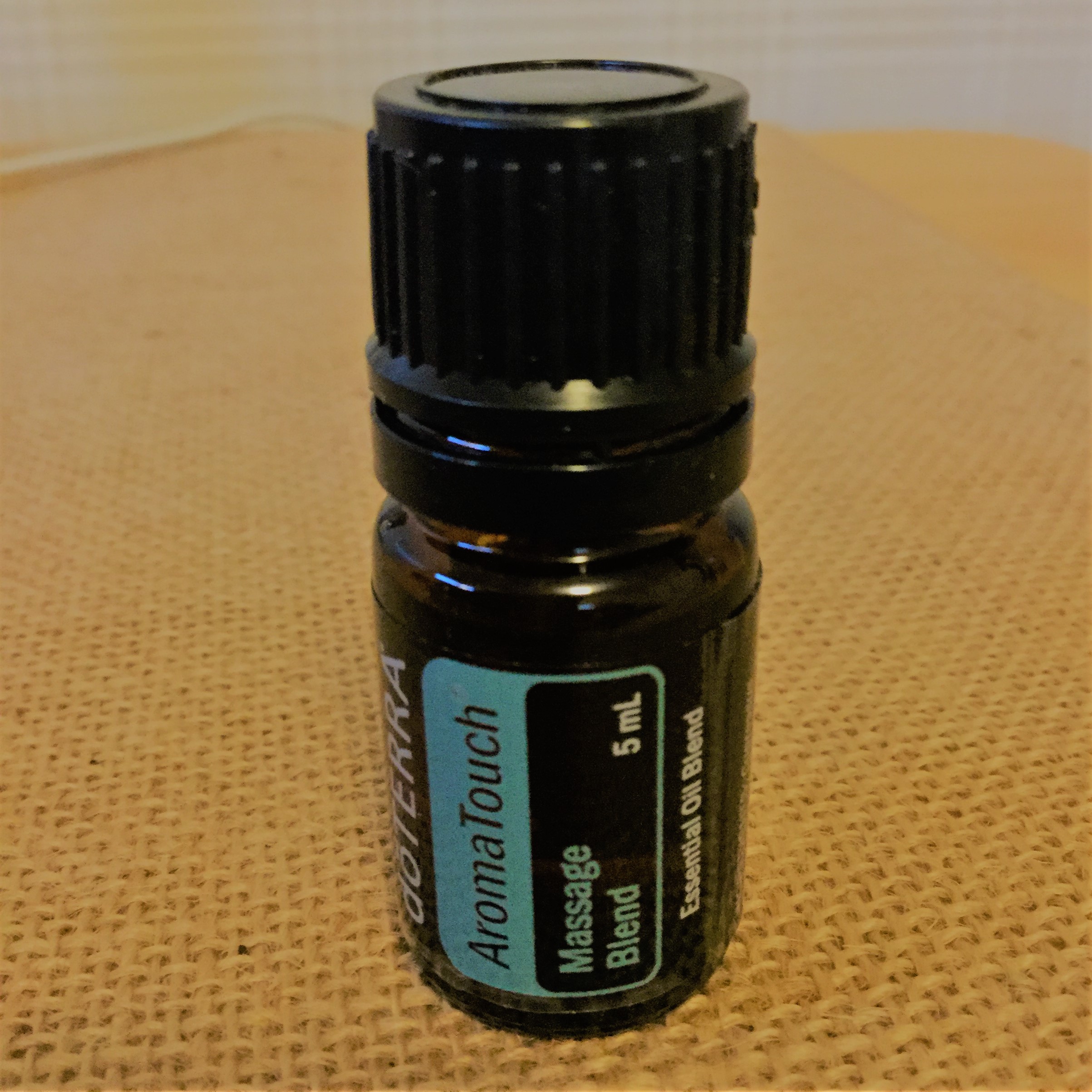
I told my dear teacher what was happening, and it turns out, she had something even better to offer. She reached into her bag, and pulled out an essential oil blend by doTerra called  AromaTouch. I rubbed a few drops in my hands and inhaled the aroma.

To my surprise, I felt better almost immediately! Odd, I thought, since I this blend is typically used as a massage oil.

Armed with the peppermint and AromaTouch blend, I placed my mat at the back of the room (just in case) and managed to get through the entire class feeling pretty good (and glad I’d showed up when I could easily have gone back to bed).

Essential Oils for Vertigo

So what, I wondered, what was in this AromaTouch blend, and were any of the ingredients known to help with nausea or dizziness?

When I got home, I looked up the product and found the list of ingredients. AromaTouch Blend contains:

  • Cypress
  • Peppermint
  • Marjoram
  • Basil
  • Grapefruit
  • Lavender

I already knew that peppermint is effective in treating dizziness and nausea. And it turns out that more than one of the other ingredients is steadying as well. In fact, when I did some research, I found this list. :

  • Peppermint
  • Cypress
  • Basil
  • Lavender
  • Tangerine

No wonder this oil blend helped my dizziness! I don’t know why they don’t market it for that purpose, but maybe they should. According to doTerra, AromaTouch is good for relaxation and stress relief, and it also helps promote circulation. All good!

In any case, now I know which ingredients to turn to the next time I feel like I’ve just gotten off a roller coaster. If you have similar symptoms, you may want to try these oils as well. If you do try them (or if you already have), let me know how they work for you!

Good Food, Bad Food; Eat This, Not That

I recently had a conversation with a man—I’ll call him Kenny—who insisted that “all foods are good.” In fact, he went beyond that to suggest “all foods are healthy.” The conversation went something like this:

Kenny: All foods are healthy.

Me: No they’re not.

Kenny: Yes they are.

Me: No they’re not

Kenny: Yes they are.

Okay, we both made some other points, and in the end we agreed more than we disagreed, but the one issue I do take with Kenny is the idea that all foods are healthy (or “good” if you want to use that word instead).

There is No Perfect Diet

Kenny is a man on a mission to dispel the idea that there is a single diet that anyone must follow in order to be healthy. I agree. But Kenny also believes that:

  • There is no such thing as a superfood.
  • GMOs pose no health risk to people.
  • If you are trying to lose weight or get healthier, you should not cut any specific food or group of foods from your diet.
  • No food has the ability to boost brain power, improve immunity, or do anything else in particular.
  • Organic foods are not better than conventional foods.
  • Additives, preservatives, and artificial ingredients are fine.

Well, Kenny. Where do I begin? I don’t disagree with all of this, but some of it is just sloppy thinking. I’ll elaborate by responding to this statement (from Kenny): “All foods are healthy; that’s why they’re called food.”

Okay, maybe Kenny and I have a different definition of food. For starters, pesticides, artificial ingredients, and the like are not substances that belong in food, so when they are added to anything intended for human consumption, I do my best to avoid that thing. Sure it’s not always possible, but it’s worth my attention.

And while it may be true that no specific food boosts brain power or improves immunity, it is certainly true that certain nutrients do. And where do we get these nutrients? Well, from certain foods, of course (but not all foods).

All Foods Are Not Healthy

So, like I said, Kenny and I went back and forth on this until it dawned on me that I didn’t really have an issue with what he was trying to say; I just had an issue with what he was actually saying (that all foods are healthy).

That part of the conversation went something like this:

Me: Diet cola is not healthy.

Kenny: Yes it is.

Me: No it’s not.

Kenny: Yes it is.

Me: No it’s not.

And then I realized I was trying to say it is not healthy, while Kenny was trying to say it is not unhealthy.

What’s the difference? Kenny’s point was if I drink a can of diet soda once in a while but my overall diet is healthy, the diet soda won’t hurt me. My point was that the diet soda does not nourish me in any useful way, so it is not healthy. And this is just me, but because it is not healthy, I choose not to drink it. Ever. Because it’s not healthy.

Don’t get me wrong, there are some things I do consume even though they probably don’t contribute to my health in any meaningful way.

This not healthy versus unhealthy issue reminded me of a point I often try to make about people. There aren’t many people I dislike, as in I actively do not like them. But there are plenty of people I don’t like, as in I am not particularly drawn to them.

Get it? Okay, back to the food.

I asked Kenny if he thought it made no difference, given a list of 100 foods, which ones I choose to eat on a regular basis. Since I didn’t actually give him a list of foods, he told me he couldn’t answer the question.

So I told him I was going to choose, bacon, lollipops, hot dogs, and diet cola. And then the next day, since all foods are good and it doesn’t matter what I eat on any given day, I would choose those same foods again. And I would keep this up every day because all foods are healthy and it doesn’t matter what I eat.

No, that was not Kenny’s point! (And yes, I knew that.)

But my point was it is not true that all foods are healthy! To be healthy, they need to nourish my body. They need to provide me with some benefit that outweighs any deficit.

Kenny thought I was trying to say there is no single axis measure by which I can compare foods and decide if one is healthier than another.

Well, of course there’s not. I wasn’t looking for one. A banana has some health-promoting minerals. An egg is a good source of protein. Leafy greens are loaded with vitamins. I can’t say that one of those foods is healthier than the others.

But they are all healthier than diet cola!

Really, Kenny? You can’t give me this one?

When I asked Kenny what is “good” about diet cola, he said it was hydrating.

Sigh.

All Foods Can Be Part of a Healthy Diet

In fairness to Kenny, I have to say he did make some good points. They were just not points that had anything to do with the purpose of the conversation, which was to flesh out what people mean when they say, “All foods are good.”

Kenny and I both agree that all foods can be part of a healthy diet. As he said, “It’s much healthier to look at your diet as a whole than to fret about individual foods.”

But he also said, “Calling certain foods ‘unhealthy’ just indicates an unhealthy relationship with food. Any food can be part of a healthy diet. No exceptions. There are foods that should probably form a larger part of your diet, and foods that should form a smaller part, but all those foods are good.”

I decided not to repeat my whole thing about how saying something is unhealthy is not the same as saying it is not healthy. So we ended the conversation like this:

Kenny: You can’t compare apples to eggs.

Me: I’m not trying to. But I’ll pass on the diet cola.

Finding Neverland and the Paradox of Growing (Up)

There’s a scene, or more precisely, a musical number, in the play Finding Neverland that captures the paradox of life perfectly—if you believe such things can happen. In the scene, the playwright J.M. Barrie and the boy Peter are singing a song called “When Your Feet Don’t Touch the Ground.”

The play is based on the story of how J.M. Barrie came to write Peter Pan. While it’s not clear how much of the play is fact, the idea is that Barrie befriended four brothers and their mom in the park while he was trying to come up with a fresh new idea for a play. The children’s father had recently died, and one of the brothers, Peter, had lost his innocence and “grown up too fast.” Barrie, on the other hand, is an adult but refuses to grow up.

In the scene I think is the play’s defining moment, Barrie is singing about flying above the clouds to cope with the pain of life: “When your feet don’t touch the earth, you can’t feel the things that hurt,” he croons.

At the same time, the boy insists his feet need to be kept on the ground and that living in a fantasy world is a mind trick that won’t do any good. “With my feet on solid ground, I can face the things that hurt,” young Peter sings.

The man singing as if he were a child and the boy singing as if he were a man is what makes this moment so powerful. But the important message is the paradox and how we must learn to live in it. We can’t dwell on the pain of life, but at the same time, we need to face our challenges. It’s how we grow.

As children, we want to grow up and do our own thing. Eventually, we become adults, and many of us find we’re no longer able to dream, imagine, or feel the joy of simply being alive that we had as children. And we think: “I’ve become too serious, too responsible, too much like the person I thought I was supposed to be. This isn’t good.” And perhaps there’s nothing sadder than seeing a child get to this point too soon.

That we need to maintain our ability to dream, believe and fantasize is a powerful and important message, but it can also be a dangerous one if we don’t learn to live in the paradox. The solution to pain and challenge is not to go back to being a child. We’re not meant to be children forever, and moving from childhood to adulthood means we have to let go of some childish things. The problem is we often let go of too much.

There’s another scene in the play when the characters are wondering if they’ve forgotten how to play. Does this mean they should be playing the way they did as children? Maybe you’ve met adults who refuse to “grow up” in any sense of the word.

Yes, children know how to have fun and dream and be whatever they want to be (at least in their own imaginations). And yes, there is value in this, but children are also dependent on others and often haven’t learned to be part of a community.

I think we’re children before we’re adults so we can learn how to give back when we come of age. It may not be politically or socially correct to say so, but there’s a downside to being a child.

While we’re not meant to be children forever, I think we are meant to maintain some of our child-like nature—and that’s the paradox. We need to hold on to the ability to escape into dreams and fantasies and stories, even as we acknowledge that none of these things can solve our problems and take away the pain of living. We need to keep some child-like qualities simply because they get us through the harsher realities of being “grown up.” We need to grow without growing up so much that we lose our connection to the magic of being a child.

How to Do More of What You Love Every Day and Still Pay the Bills

Do what you love is a theme that comes up a lot in modern circles. There are variations on the theme, and chances are you’ve heard some of these as well:

Do more of what you love

Today my yoga teacher suggested an activity that was a twist on the usual “to do” list. The task was to make a list of things we enjoy doing and then spend this day (which happened to be a Monday) doing what we want to do.

Ah, if only I had that luxury, I thought. I’d probably go get a pedicure and then pack for a week away at luxury yoga retreat, maybe one that includes learning how to draw or paint. But unfortunately, there are bills to pay. And without getting into details, as a responsible adult, I have to make that a priority right now, so…

I could not afford the luxury of being sure to have some fun today.

But wait. Life should be fun, shouldn’t it?

I don’t advocate being miserable. I’ve shown that in my life by leaving one or two dead-end jobs and opting out of activities and relationships that don’t help me grow and live in love. But how do those of us who need to make a living manage the do what you love thing?

Well, how about this? If you can’t do what you love every minute of the day, then find a way to love what you do. Or at least find a way to not be miserable while you’re doing it.

A while ago, I wrote about how I’ve learned to turn some of the more tedious aspects of my work, like dry technical editing or grocery shopping, into meditations. (Seriously, next time you go grocery shopping, try to go slowly and really notice the colorful array of fruits and vegetables in the produce section or the myriad choices you have if you want a dozen eggs or a container of yogurt!)

Doing more of what we love each day is important, and so is taking care of our responsibilities. So, if you can’t quit your job or ignore a deadline to spend the entire day today doing things on your what I love to do list, try loving the simple fact that you’re alive and functioning, and love (or at least like) whatever you need to do.

The fact that you’re able to do anything is something worth appreciating. So despite the fact that I can’t do something I’m in love with every second of every day, here’s a short list of the things I’ve loved doing in just the last 24 hours:

  • I drank more than one delicious cup of coffee.
  • I ate a yummy breakfast, lunch, and dinner.
  • I went to an awesome yoga class.
  • I watched my favorite MLB team win (again)!
  • I watched a fascinating drama on television.
  • I listened to some of my favorite music.
  • I noticed the lilies in a bouquet of flowers I bought a few days ago have bloomed and are gorgeous.
  • I did my “editing meditation.”
  • I wrote this latest entry for my blog.
  • And of course, I practiced yoga!

What will you love doing today?

Samson and Buster

SamsonandBuster

Samson wanted to play. Samson always wanted to play.

Buster wanted to sit. Buster liked to sit. He felt very peaceful when he was left alone to sit. He especially liked when there was an empty box to sit on. When he got tired of sitting, he could scratch the box and sharpen his claws.

Buster sat peacefully on an empty box. A blur whizzed by. Samson had a bottle cap that he found on the kitchen table. He swatted it across the living room. Samson followed in a flash. He almost toppled on his side as he ran.

“It was so peaceful before that little guy got here,” Buster thought.

Samson stopped playing with the bottle cap. He padded toward Buster and looked at the box curiously. He wanted to find out what it was like to sit on that box, too. So he hopped up next to Buster.

“Hsssssssssssssssssssssssssssssss!” Buster snapped, bearing his teeth. He looked like he was smiling. He stood and stepped off the box as though he didn’t really mean to hiss. He backed up a few steps and sat straight and tall. Then he shook his head and walked away. There was another box behind the sofa. That one had a hole cut in it for Buster to hide in. He would go there for a while to find some peace.

Thump!

Samson climbed onto the sofa to see where Buster had gone. Then he jumped on top of the box Buster was hiding in. Buster was startled, but he didn’t move. Samson crouched at the edge of the box and stuck his paw into the hole.

“M’ow!” Buster said quickly. It was only a half meow, but it worked. Samson pulled his paw back. There had to be a way to get Buster to play. He decided to go explore the attic and come back later. Maybe then Buster would play.

There were so many boxes in the attic! Most of them had lids or were sealed shut. Samson climbed from box to box and pawed at the ones that weren’t closed tightly. One box had no lid. It was filled with books and old toys. Samson picked up a small cloth doll in his teeth and carried it across the floor.

Then Samson saw a tall metal cabinet. The door was slightly opened. He dropped the doll and stuck his paw through the opening. There were clothes hanging in there! He could swat at them and try to pull them down! He did this for a while, but he couldn’t get anything down.

Finally Samson decided to take a short nap. He curled up in a ball on an old mattress. But he never fell asleep. As soon as he shut his eyes, he heard paw-steps on the attic stairs. Buster wanted to see what Samson was doing. He looked at Samson curled up on the mattress. Then he saw another mattress leaning up against the wall. Buster sat straight and tall and looked up at the mattress. There was a window right next to it. He could see out the window from the top of the mattress! So Buster jumped up. He landed on top of the mattress and looked out the window.

Samson was curious. He saw that Buster had spotted a window. He wanted to see out the window, too. Samson trotted toward Buster and the window. Could he get up there, too?

“Hssssssssssssssssssssssssss!” Buster said as Samson jumped up. But Buster hardly moved when he hissed. Samson wondered if Buster would swat at him and try to knock him down. But Buster just sat up and backed to the edge of the mattress. He left enough room for Samson to land.

They could both look out the window!

Buster and Samson sat together. They watched the cars driving by on the street below. They watched the birds fly from tree to tree. And they watched as their buddy, Mike, came home from work.

Now Buster and Samson knew it was time to stop looking out the window. Mike was home. It was food time! Buster raced Samson down two flights of stairs to the kitchen, just in time to hear the lid pop off their favorite cat food!

Samson and Buster ran to their bowls. They enjoyed a delicious seafood dinner, side by side.

Wake Up!

This morning, my sweet yoga teacher encouraged me to wake up. Not directly, as in, “Wake up and pay attention, Maria. You look a little sleepy today!” It was a general teaching for the class. But it caught my attention.

I was a little sleepy and a bit slow getting going and getting to class today, which is not completely unusual for me, especially on gray winter mornings.

Another reason the topic caught my attention is just an hour or so earlier over morning coffee, my husband and I were kicking around the concept of “waking up” in the sense of clearing cobwebs from our brains and becoming more focused and productive.

Awakening in Yoga and in Life

Then I got to class, where our teacher shared some wisdom she’d learned at a workshop she’d recently attended. The workshop leader was Guru Singh. Coincidentally, I recently read his book, “Buried Treasures.”

When I walked into class and saw another one of Guru Singh’s books at the front of the room, I paid attention. There was yoga again getting to the heart of whatever is happening in my life.

We talk about awakening a lot in yoga. As our teacher (via Guru Singh) explained, it’s something that’s always available. In my own practice, I’ve found when I learn to pay attention, I open my eyes, heart, and mind to what is and what has always been. And it seems the more I pay attention, the more I realize I’ve spent a lot of time napping.

Are you ready to wake up?

There are things I’ve always been ready for (like starting a yoga practice). I wasn’t aware it was something I was meant to do until, one day, there it was. Often we dabble and go slowly because we’re not sure something is meant for us.

On the other hand, some things keep coming up, but we haven’t figured out how to do them or where to begin.

Your teacher is already here

They say when the student is ready the teacher will appear. But if Guru Singh’s position resonates with you and you believe you have always been ready for the thing you’re meant for, then maybe the real issue is you’re not awake. You don’t see that your teacher is already here.

Fear not, my friend. All you have to do is wake up and pay attention!

Letting Go of What Doesn’t Serve You and Embracing What Does

At a yoga class during the last week of 2014, my fellow students and I were asked to focus on something that no longer served us, something we wanted to let go of as we move into the new year. Suspecting this theme would come up, I already had some ideas in mind when I got to class that morning.

Letting Go

There are many things in my life that don’t serve me. I hold on to most of them because I’m not sure what the alternatives are and because most of them don’t really harm me either. It would be easy to let go of the old if we knew where we wanted to go and how to get there.

That said, there are certainly things I need to release, like regret. Regret serves no purpose; it’s not even filling space until I figure out what to do next with my life. It just makes me miserable. I can’t change the experiences I’ve had or the choices of made in the past. So I need to let go of regret and accept that what’s done (or not done) is history.

After regret, I want to let go of apologizing for who I am. I’ve had some great practice at this recently. I said no more than once without feeling (too) guilty about it, something that isn’t easy for me to do. I was being pulled in too many directions, and I was overwhelmed, so I had to say a few nos so I’d have the energy to be fully present when I did say yes.

Message from the Angels

At the end of class, we all picked from a deck of angel cards, an activity that always gets me thinking and often writing too. I wondered if I’d pick the word “regret” or “guilt.” That would be an awesome clear sign from the universe that I’m on the right track.

Instead, my word was “support.”

I stared at the card for a few moments because it didn’t seem right at all. Was this card suggesting I need to be more supportive? I quickly eliminated that idea. It seems (to me anyway) that one thing I do a lot of is listen to and support others. In fact, I’d been deep into support mode the last few weeks following an event that caused a swell of emotional turmoil for some of the people in my life. I found myself listening a lot, and I was told more than once it was good talking to me.

So why was I holding this card? It wasn’t telling me I should let go of my role of being supportive, was it? That didn’t seem right either.

Then it dawned on me that support was the right word for me after all. It’s not that I need to be more or less supportive, but that I need to stop denying I also need support. I’ve been cast in the role of listener for so long that I’ve learned to act like I don’t need to be heard. What is that really about?

Know What You Need

For me, acknowledging that I also need support presents a problem because of how good I’ve gotten at not seeking it. It’s probably the same for you, whether maybe with the same issue or maybe with something completely different.

Once you acknowledge what you need to release and what you want to embrace, the real work begins.

Maybe the best thing I can do right now is put the intention out to the universe. Rather than asking specific people to support me, I can ask the universe for support and see where it leads me. The universe is much more likely to come through, though I’m sure that when it does it will send me people who can help me find my way. My job is be open to that.

Lifting each other up

In case I had any doubts that I gotten the right message in class that morning, the song playing during savasana drove it home for me in that awesome way that things have of coming together when you’re open it. The chorus goes like this:

We shall lift each other up.

Higher and higher,

We shall lift each other up.

Lifting each other up is a great way to think about support. It doesn’t have to be one-sided. Just think how high we all could climb if we helped each other along the way! So I ask the universe for support in letting go of regret and learning to be myself without apology.

What Will You Let Go Of?

As you move into the new year, what will you release? And once you release it, what will you embrace? You may not know exactly what you need or how you’ll get it, but now is the time to take a new step. Set an intention and let the universe support you.

A very Happy New Year to all!

Who Are You Supposed to Be?

In “The Great Work of Your Life” – a book about dharma, author Stephen Cope notes that Walt Whitman was 47 years old when he found the “true calling” he had been preparing for all his life. When I first read that, a spark of hope went through me. Until that moment, I’d thought I was long past the age when such a thing could happen. And here’s the real surprise. Whitman’s calling was not writing; it was nursing!

It Can Take a Lifetime to Find Your Dharma

When I read Cope’s book a few years ago, I wondered if all the wandering I’ve done from “calling” to “calling” was leading me to something specific I could call my dharma. I hoped so, because the disjointed confusing road was a challenge to travel.

Don’t Do What You’re Not Supposed to Do

I’m not sure I know what I’m supposed to do. I do know what I’m not supposed to do. I usually figure that out shortly after I start doing a something, like studying to be a dietitian instead of a holistic nutritionist or taking a job as a financial aid representative when I really want to be a student counselor. But I continue to hope all of those starts and detours have a purpose.

I do sometimes think a good way to figure out what you’re supposed to do is to figure out what you’re not supposed to do.

Learning to Be Who We Are

I’m not a physicist (and have never even considered the possibility I should be, though it would be fascinating). I’m no longer a financial aid representative, and I now know I’m not meant to be a clinical dietitian. What I am supposed to be is a writer.

Writing has been part of my life (and my dharma) for a long time. All the things I’ve done or attempted to do have shaped the kind of writer and editor I am now. In college, I wrote fiction. Just after that, I did a lot of journal writing. In an odd, Zen-like way, I destroyed my journals in the early 2000’s to detach from the stories they told. I wrote journal entries as if I was writing fiction. More recently my writing ranges from technical to creative nonfiction.

Now most of my writing is more practical. Some is even technical. It’s almost all nonfiction.

No doubt there’s a reason it took me almost 20 years to return to writing as a career. I’ve written a lot about psychology and nutrition (and, of course yoga) in the last ten years. And while there may not be a formal title for what I am, I’m pretty sure it is what I’m supposed to do.

What are you supposed to be?

Do you know what you’re supposed to be? Have you found your dharma, and if you have, does it have a name? If you’re still not sure despite years of searching, don’t despair. It takes a seed many years to become a mighty tree.

Surrender to Enthusiasm

We did a new activity in yoga class last week. My teacher suggested it’s was not an accident. Towards the end of an invigorating hour of practice that started with dancing to warm up, she came around and asked us to pick a card from a deck. Each card contained a word.

When she came to me, I noticed a card sticking out of the pile, but something told me I should pick another that was tucked a bit deeper into the pack. The card said “surrender.”

My first reaction was, “No. I really don’t want to.” And at the same time, I realized I might not have a choice. I’d been was thinking of giving up on something I could no longer control that was not serving me well.

After offering the deck of cards to the last student, the teacher came back to me with another card. “I have to give you this one too, because it pretty much jumped out at you!” she exclaimed.

The card say “enthusiasm.”

That one bugged me a bit because I didn’t feel like I always had the energy for enthusiasm, though I suppose that depends on how the word is defined. I was conscious that during the dance warm up at the beginning of class, for example, there was a physical limitation holding me back.

But back to the cards. It was easy to notice these two words formed a short but powerful sentence: Surrender to enthusiasm.

Opportunities for Enthusiastic Surrender

I thought about my little sentence on the drive home. Why not believe the message was meant to reach me at this moment? I immediately felt energized. But what, I thought, do I need to surrender to?

Maybe I need to surrender to others’ enthusiasm for things. Perhaps the yoga gods are telling me, for example, to stop wishing my husband would stop talking about buying a motorcycle. Or maybe the message was sent to help me deal with a member of my extended family whose exaggerated, enthusiastic tales often test my patience.

Or, it could be that it’s time for me to surrender to my own enthusiasm for something, which I think shows itself in calmer way. In fact, maybe I need to be OK with that instead of letting it stop me.

Just that morning, I’d been thinking about yoga teacher training and what holds me back from enrolling in one. Besides the money and time commitment (neither of which is as easy to work around at it would have been in the past), I’m afraid having the job of teaching yoga will ruin my enthusiasm for the practice. I think that fear comes from my experience as a public school teacher, when my love of learning was seriously challenged by having to deal with reluctant students, politics, lesson plans, and all the other things learning is not about.

I also haven’t found the right teacher or program for me. And I think that’s important.

And in case you missed the message the first time

When I got home from class, I returned to a book editing project I’d been working on for weeks. The book is about yoga and other tools for living a healthy, blissful life. Within moments, this sentence jumped off a page I was editing: When you are willing to surrender into greater energy, nothing is lacking.

The context was setting intentions for a life-changing practice that involves yoga, nutrition, breathing, meditation and other aspects of mind, body and spirit.

Hmmm, maybe that energy I’m worried about not having will be there when I need it after all.

Moments after that, my other word appeared, this time in a sentence about taking time each day to sit for five minutes and formally set an intention: Do it with enthusiasm. This is where you start manifesting your dream.

Now my surrender was about something very different than I initially feared. It was not about giving up, but about allowing something to come through and allowing it to come through with intention and enthusiasm. It could be my own brand of quiet enthusiasm, and that’s really OK.

I’m going to pay attention, so I’ll recognize that thing when it shows up and wants to come through.

They say that when the student is ready the teacher will appear. I did sign up for another writing course.

Previous Older Entries Next Newer Entries

Maria is a health and wellness writer and certified yoga instructor with a background in education, psychology, and nutrition. She has written hundreds of pages of content for clients in health-related fields, particularly those specializing in yoga, natural medicine, nutrition, psychology, and spiritual health and healing. She is also the author of "Yoga Circles, a Guide for Creating Community of the Mat." In addition to writing, Maria has worked as a nutritionist, teacher, and technical/nonfiction editor. To learn more about her writing, visit www.wellbeingwriter.net.