In Baseball and In Life: Sometimes the Outcome Just Sucks!

If you happen to be a New York baseball fan like I am (and not who cheers for that team in the Bronx), you probably had a bit of a broken heart recently when the Mets lost the World Series.

I use the term “lost” loosely, because if you know baseball, and if you watched these games, you might consider “gave away” or “blew” more appropriate terms.

It’s Just Baseball, Right?

Anyone who spends the better part of six months cheering on a baseball team with the emotions of a die-hard fan has probably wondered why these emotions are so strong at times. It’s strange, isn’t it? You know it’s just a game. You know that your real life will go on whether your team wins or loses. You know you have nothing to do with whether or not they win or lose, and you know there’s big marketing behind the hype and drama that draws you in.

And yet you can’t help the fact that somehow it matters. When your team loses the big games, it stings.

The Yoga of Baseball

If you’re also a yogi like I am, when things like this happen, you immediately try to be all yogic about it. After all, yoga gives us many tools for dealing with disappointment, frustration, and loss—the most obvious and appropriate being the law of non-attachment.

Well, you know what fellow New York sports fan yogis (and everyone else)? It’s okay. Go ahead and be sad—and angry—and disappointed. Just for a while. (And yes, keep your real life in perspective.)

No, it didn’t happen for reason. No, there is nothing to be learned or gained from watching a pitcher pitch the game of his life for 8 innings only to blow it within minutes in the top of the ninth. There’s no great life lesson in the fact that your team, which was not expected to make the playoffs much less be in the World Series, had a surprising, fun, and amazing season—and then broke your heart, for a moment, in the end.

It just sucks!

So feel that for a while. Mope, brood, yell. Do whatever you need to do. But just for a while.

Then you can come back and be all yogic about it. If you like, you can try to make sense of it all, because as all baseball fans know, baseball is a lot like life. And as you try to make sense of it all—because baseball is a lot like life—don’t forget to be grateful for the fun, and don’t forget to feel the joy.

Opening Day is only five months away!

Namaste.

My Awesome Experience With Reiki, A Crystal, and a Healer’s Visions

reikiFor a while now, I’ve wanted to explore alternative methods of healing. I’ve always been interested in going beyond what’s mainstream. So when I was recently invited to try reiki—a healing technique I’d heard of but knew little about—I happily accepted the invitation.

When I think of reiki, I remember an episode of “Everybody Loves Raymond.” Debra treats herself to a reiki session and Ray flips out because she’s paid money for “a massage where they don’t even touch you”! But Debra insists she feels great after the experience.

It’s true that reiki is not like other kinds of massage. In fact, it’s more accurate to call it a form of energy healing I think. Jeanne Placier, a yoga teacher and healer who invited me to try reiki at her new location in Ridgewood, NJ, explained that reiki is an exchange of energy in which the practitioner holds her hands just above or lightly on various parts of the body.

I have a feeling Jeanne’s reiki sessions are beyond ordinary even for reiki. When I walked into her massage room, I instantly felt relaxed. I’m sure this had something to do with Jeanne’s friendly personality as well as the peaceful décor. There is definitely a special energy in her space.

Healing Crystals

Before we started, Jeanne and I talked a bit, and she asked me if I’d like to hold a crystal during the session. I had no idea why she was asking, but I said, “Sure. Why not?” She offered me an amethyst crystal because I’d just mentioned my strong attraction to third eye energy. While the color for the sixth chakra is traditionally indigo, Jeanne said she likes to use amethyst, which can be used for both the sixth and seventh (crown) chakras.

Later, I asked Jeanne she had offered me the crystal. She explained that the gems enhance the energy-healing experience. “I’ve always been drawn to crystals and colors, especially in jewelry,” she told me. “As I got older, I started to understand their healing properties and started to collect them to wear, admire and use for healing.”

Jeanne is someone who trusts her intuition, and that trust pays off. She went on to explain that sometimes a client has something going on that he or she prefers not to share, but in choosing a crystal, that person instinctively chooses a color that corresponds to whatever is going on.

After the session, if the person is interested, Jeanne shares information about the properties of the crystals the person chose. “It’s always dead-on related to an issue they have,” she said. “The experience is inspiring to most clients because they learn that they truly know how to heal themselves.”

My Reiki Experience

Still not exactly sure what to expect, I settled onto the massage table, holding the lovely amethyst crystal in one hand. Jeanne then explained a bit more about what to expect; she told me that people have a variety of experiences with reiki. Some see colors or “something comes up,” she said. “Others report feeling very relaxed and lighter.”

It must take a lot of courage, I thought, to offer this kind of service and trust the outcome.

According to The International Center for Reiki Training, the word reiki can be loosely translated to mean God energy. If the word God doesn’t work for you, call it the energy of the universe or a higher power. Reiki works, says Reiki Master William Lee Rand, by changing the vibratory level of the energy field around a person’s body. The benefits can be physical, emotional, and/or spiritual. During a session, there’s an exchange of energy between client and healer.

The exact nature of the exchange, as I understand it, depends on what’s being worked on—a headache, emotional issue, back pain, or chronic fatigue, for example.

As Jeanne began to work on me, I immediately felt intense heat radiating from her hands, which she held in various spots around my head. I didn’t know until later that she stayed in that space because, she said, “There was a lot going on there.”

A lot going on in my head? Sounds about right, though in recent years I’ve tried to lessen the noise with the help of my yoga and meditation practice.

Oddly, I also had the sensation that my throat was constricted. It wasn’t something I expected to experience during a healing treatment, but I definitely felt it for a few minutes. Then I started to feel very relaxed and the sensation of constriction went away.

Light and Color

I was in a more or less meditative state for a while when I began to see an intense bright white light. Though my eyes were closed, my first thought was it must be the sun coming out from behind some clouds and shining through the window. But it was so intense that I began to suspect it was something more.

As I focused on the light, it turned green. I waited to see other colors—in fact I tried to see other colors (Is that allowed?)—but I only saw green. The green then dissipated, and I drifted back into a meditative state.

Then again: intense bright white light that faded and turned green. Throughout the entire experience, I continued to feel the comforting warmth that radiated from Jeanne’s hands.

When the session was over, Jeanne asked me about my experience. I told her about the constriction and the white and green light. I already knew that green is the color of the heart chakra. Maybe the constriction had some connection. I often feel like I can’t speak my truth to loved ones for various reasons—not because I don’t trust my truth but because my loved ones have trouble receiving what I tell them. Rather than cause conflict, I often choose to stay silent. The white light, of course, is the crown chakra, my strong connection with intuition and a higher power.

A Healer’s Visions

dollI thought that was the end of the session, but to my surprise, there was more. Jeanne shared some visions she had while working with my energy. She told me she saw a newly paved black road (“like brand new and freshly paved,” she emphasized) and a beautiful goldfinch with bright yellow feathers and a black crown. She also saw a little girl dressed in a pinafore holding an old-fashioned doll, the kind with arms and legs that move.

I paused and digested this, struck by the image of the little girl with the doll. We talked a bit about the obvious symbolism of the “new road” and the bird (which can fly), and I agreed it was related to the book project I’m working on.

The little girl in the pinafore holding a doll made sense to me as well. She was me, of course, and while I’m not quite sure why she showed up, I knew exactly what she was wearing. It was a pinafore with a blue and red flowery print my mother made for me when I was a child. Just the other day when I visited my mom, she was repairing this very garment, which she’d found in her attic! The doll  was one of two cherished toys I still have from my childhood; it was a gift from my grandparents, who brought it back from Italy when I was six years old.

The Goldfinch

I left Jeanne’s space intrigued with all of this symbolism and imagery. I knew for sure that a freshly paved black road was important symbolism for my life. As always, I was making an effort to move beyond the past. But what about the goldfinch? Its golden color, we’d decided, is associated with the solar plexus chakra—the center of power. And of course it has the ability to fly. But I wondered what else the goldfinch symbolizes.

So I went home and looked it up.

According to Spirit Lodge, as a spirit animal, “the presence of goldfinches usually indicates an awakening to the activities of those beings that are normally relegated to the realm of fiction.” The beings in question include angels, fairies and the like.

And maybe also things like reiki if you have a skeptic’s mind going in.

Perhaps more importantly, goldfinches are said to help us understand the value of change. In particular, they can give us the “ability to resolve family conflicts in a healthy manner, creating balance in dealing with different people.” Goldfinches give us an “understanding (of) the power of voice.”

Wow.

So if I put this all together, I need to speak my truth in a new way—a more effective way, I guess, and I can do that on my journey down that freshly paved road. The little girl holding the doll—my former self, a child who always quietly and respectfully held back so as not to get in trouble is no longer who I am.

There’s Always More

Obviously, there are lots of ways I could have put the pieces of my reiki experience together, but the point is like yoga, reiki seems to be a practices you turn to for one reason that ends up offering so much more than you imagined it would.

As it turns out, reiki is not only relaxing and healing, it’s an excellent tool for self-discovery if one is open to that kind of thing. Of course, you’ll need to find a practitioner who is right for you to work with. In my case, Jeanne’s down-to-earth friendly nature and her amazing power as a healer worked perfectly for me.

So what about you? If you haven’t experienced reiki, why not give it a try? If you can find a reiki practitioner you click with, you might be inspired and surprised by all this practice has to offer. If you’ve already discovered the practice, I’d love to hear about your reiki experience!


Finding Neverland and the Paradox of Growing (Up)

There’s a scene, or more precisely, a musical number, in the play Finding Neverland that captures the paradox of life perfectly—if you believe such things can happen. In the scene, the playwright J.M. Barrie and the boy Peter are singing a song called “When Your Feet Don’t Touch the Ground.”

The play is based on the story of how J.M. Barrie came to write Peter Pan. While it’s not clear how much of the play is fact, the idea is that Barrie befriended four brothers and their mom in the park while he was trying to come up with a fresh new idea for a play. The children’s father had recently died, and one of the brothers, Peter, had lost his innocence and “grown up too fast.” Barrie, on the other hand, is an adult but refuses to grow up.

In the scene I think is the play’s defining moment, Barrie is singing about flying above the clouds to cope with the pain of life: “When your feet don’t touch the earth, you can’t feel the things that hurt,” he croons.

At the same time, the boy insists his feet need to be kept on the ground and that living in a fantasy world is a mind trick that won’t do any good. “With my feet on solid ground, I can face the things that hurt,” young Peter sings.

The man singing as if he were a child and the boy singing as if he were a man is what makes this moment so powerful. But the important message is the paradox and how we must learn to live in it. We can’t dwell on the pain of life, but at the same time, we need to face our challenges. It’s how we grow.

As children, we want to grow up and do our own thing. Eventually, we become adults, and many of us find we’re no longer able to dream, imagine, or feel the joy of simply being alive that we had as children. And we think: “I’ve become too serious, too responsible, too much like the person I thought I was supposed to be. This isn’t good.” And perhaps there’s nothing sadder than seeing a child get to this point too soon.

That we need to maintain our ability to dream, believe and fantasize is a powerful and important message, but it can also be a dangerous one if we don’t learn to live in the paradox. The solution to pain and challenge is not to go back to being a child. We’re not meant to be children forever, and moving from childhood to adulthood means we have to let go of some childish things. The problem is we often let go of too much.

There’s another scene in the play when the characters are wondering if they’ve forgotten how to play. Does this mean they should be playing the way they did as children? Maybe you’ve met adults who refuse to “grow up” in any sense of the word.

Yes, children know how to have fun and dream and be whatever they want to be (at least in their own imaginations). And yes, there is value in this, but children are also dependent on others and often haven’t learned to be part of a community.

I think we’re children before we’re adults so we can learn how to give back when we come of age. It may not be politically or socially correct to say so, but there’s a downside to being a child.

While we’re not meant to be children forever, I think we are meant to maintain some of our child-like nature—and that’s the paradox. We need to hold on to the ability to escape into dreams and fantasies and stories, even as we acknowledge that none of these things can solve our problems and take away the pain of living. We need to keep some child-like qualities simply because they get us through the harsher realities of being “grown up.” We need to grow without growing up so much that we lose our connection to the magic of being a child.

How to Do More of What You Love Every Day and Still Pay the Bills

Do what you love is a theme that comes up a lot in modern circles. There are variations on the theme, and chances are you’ve heard some of these as well:

Do more of what you love

Today my yoga teacher suggested an activity that was a twist on the usual “to do” list. The task was to make a list of things we enjoy doing and then spend this day (which happened to be a Monday) doing what we want to do.

Ah, if only I had that luxury, I thought. I’d probably go get a pedicure and then pack for a week away at luxury yoga retreat, maybe one that includes learning how to draw or paint. But unfortunately, there are bills to pay. And without getting into details, as a responsible adult, I have to make that a priority right now, so…

I could not afford the luxury of being sure to have some fun today.

But wait. Life should be fun, shouldn’t it?

I don’t advocate being miserable. I’ve shown that in my life by leaving one or two dead-end jobs and opting out of activities and relationships that don’t help me grow and live in love. But how do those of us who need to make a living manage the do what you love thing?

Well, how about this? If you can’t do what you love every minute of the day, then find a way to love what you do. Or at least find a way to not be miserable while you’re doing it.

A while ago, I wrote about how I’ve learned to turn some of the more tedious aspects of my work, like dry technical editing or grocery shopping, into meditations. (Seriously, next time you go grocery shopping, try to go slowly and really notice the colorful array of fruits and vegetables in the produce section or the myriad choices you have if you want a dozen eggs or a container of yogurt!)

Doing more of what we love each day is important, and so is taking care of our responsibilities. So, if you can’t quit your job or ignore a deadline to spend the entire day today doing things on your what I love to do list, try loving the simple fact that you’re alive and functioning, and love (or at least like) whatever you need to do.

The fact that you’re able to do anything is something worth appreciating. So despite the fact that I can’t do something I’m in love with every second of every day, here’s a short list of the things I’ve loved doing in just the last 24 hours:

  • I drank more than one delicious cup of coffee.
  • I ate a yummy breakfast, lunch, and dinner.
  • I went to an awesome yoga class.
  • I watched my favorite MLB team win (again)!
  • I watched a fascinating drama on television.
  • I listened to some of my favorite music.
  • I noticed the lilies in a bouquet of flowers I bought a few days ago have bloomed and are gorgeous.
  • I did my “editing meditation.”
  • I wrote this latest entry for my blog.
  • And of course, I practiced yoga!

What will you love doing today?

Wake Up!

This morning, my sweet yoga teacher encouraged me to wake up. Not directly, as in, “Wake up and pay attention, Maria. You look a little sleepy today!” It was a general teaching for the class. But it caught my attention.

I was a little sleepy and a bit slow getting going and getting to class today, which is not completely unusual for me, especially on gray winter mornings.

Another reason the topic caught my attention is just an hour or so earlier over morning coffee, my husband and I were kicking around the concept of “waking up” in the sense of clearing cobwebs from our brains and becoming more focused and productive.

Awakening in Yoga and in Life

Then I got to class, where our teacher shared some wisdom she’d learned at a workshop she’d recently attended. The workshop leader was Guru Singh. Coincidentally, I recently read his book, “Buried Treasures.”

When I walked into class and saw another one of Guru Singh’s books at the front of the room, I paid attention. There was yoga again getting to the heart of whatever is happening in my life.

We talk about awakening a lot in yoga. As our teacher (via Guru Singh) explained, it’s something that’s always available. In my own practice, I’ve found when I learn to pay attention, I open my eyes, heart, and mind to what is and what has always been. And it seems the more I pay attention, the more I realize I’ve spent a lot of time napping.

Are you ready to wake up?

There are things I’ve always been ready for (like starting a yoga practice). I wasn’t aware it was something I was meant to do until, one day, there it was. Often we dabble and go slowly because we’re not sure something is meant for us.

On the other hand, some things keep coming up, but we haven’t figured out how to do them or where to begin.

Your teacher is already here

They say when the student is ready the teacher will appear. But if Guru Singh’s position resonates with you and you believe you have always been ready for the thing you’re meant for, then maybe the real issue is you’re not awake. You don’t see that your teacher is already here.

Fear not, my friend. All you have to do is wake up and pay attention!

Letting Go of What Doesn’t Serve You and Embracing What Does

At a yoga class during the last week of 2014, my fellow students and I were asked to focus on something that no longer served us, something we wanted to let go of as we move into the new year. Suspecting this theme would come up, I already had some ideas in mind when I got to class that morning.

Letting Go

There are many things in my life that don’t serve me. I hold on to most of them because I’m not sure what the alternatives are and because most of them don’t really harm me either. It would be easy to let go of the old if we knew where we wanted to go and how to get there.

That said, there are certainly things I need to release, like regret. Regret serves no purpose; it’s not even filling space until I figure out what to do next with my life. It just makes me miserable. I can’t change the experiences I’ve had or the choices of made in the past. So I need to let go of regret and accept that what’s done (or not done) is history.

After regret, I want to let go of apologizing for who I am. I’ve had some great practice at this recently. I said no more than once without feeling (too) guilty about it, something that isn’t easy for me to do. I was being pulled in too many directions, and I was overwhelmed, so I had to say a few nos so I’d have the energy to be fully present when I did say yes.

Message from the Angels

At the end of class, we all picked from a deck of angel cards, an activity that always gets me thinking and often writing too. I wondered if I’d pick the word “regret” or “guilt.” That would be an awesome clear sign from the universe that I’m on the right track.

Instead, my word was “support.”

I stared at the card for a few moments because it didn’t seem right at all. Was this card suggesting I need to be more supportive? I quickly eliminated that idea. It seems (to me anyway) that one thing I do a lot of is listen to and support others. In fact, I’d been deep into support mode the last few weeks following an event that caused a swell of emotional turmoil for some of the people in my life. I found myself listening a lot, and I was told more than once it was good talking to me.

So why was I holding this card? It wasn’t telling me I should let go of my role of being supportive, was it? That didn’t seem right either.

Then it dawned on me that support was the right word for me after all. It’s not that I need to be more or less supportive, but that I need to stop denying I also need support. I’ve been cast in the role of listener for so long that I’ve learned to act like I don’t need to be heard. What is that really about?

Know What You Need

For me, acknowledging that I also need support presents a problem because of how good I’ve gotten at not seeking it. It’s probably the same for you, whether maybe with the same issue or maybe with something completely different.

Once you acknowledge what you need to release and what you want to embrace, the real work begins.

Maybe the best thing I can do right now is put the intention out to the universe. Rather than asking specific people to support me, I can ask the universe for support and see where it leads me. The universe is much more likely to come through, though I’m sure that when it does it will send me people who can help me find my way. My job is be open to that.

Lifting each other up

In case I had any doubts that I gotten the right message in class that morning, the song playing during savasana drove it home for me in that awesome way that things have of coming together when you’re open it. The chorus goes like this:

We shall lift each other up.

Higher and higher,

We shall lift each other up.

Lifting each other up is a great way to think about support. It doesn’t have to be one-sided. Just think how high we all could climb if we helped each other along the way! So I ask the universe for support in letting go of regret and learning to be myself without apology.

What Will You Let Go Of?

As you move into the new year, what will you release? And once you release it, what will you embrace? You may not know exactly what you need or how you’ll get it, but now is the time to take a new step. Set an intention and let the universe support you.

A very Happy New Year to all!

Who Are You Supposed to Be?

In “The Great Work of Your Life” – a book about dharma, author Stephen Cope notes that Walt Whitman was 47 years old when he found the “true calling” he had been preparing for all his life. When I first read that, a spark of hope went through me. Until that moment, I’d thought I was long past the age when such a thing could happen. And here’s the real surprise. Whitman’s calling was not writing; it was nursing!

It Can Take a Lifetime to Find Your Dharma

When I read Cope’s book a few years ago, I wondered if all the wandering I’ve done from “calling” to “calling” was leading me to something specific I could call my dharma. I hoped so, because the disjointed confusing road was a challenge to travel.

Don’t Do What You’re Not Supposed to Do

I’m not sure I know what I’m supposed to do. I do know what I’m not supposed to do. I usually figure that out shortly after I start doing a something, like studying to be a dietitian instead of a holistic nutritionist or taking a job as a financial aid representative when I really want to be a student counselor. But I continue to hope all of those starts and detours have a purpose.

I do sometimes think a good way to figure out what you’re supposed to do is to figure out what you’re not supposed to do.

Learning to Be Who We Are

I’m not a physicist (and have never even considered the possibility I should be, though it would be fascinating). I’m no longer a financial aid representative, and I now know I’m not meant to be a clinical dietitian. What I am supposed to be is a writer.

Writing has been part of my life (and my dharma) for a long time. All the things I’ve done or attempted to do have shaped the kind of writer and editor I am now. In college, I wrote fiction. Just after that, I did a lot of journal writing. In an odd, Zen-like way, I destroyed my journals in the early 2000’s to detach from the stories they told. I wrote journal entries as if I was writing fiction. More recently my writing ranges from technical to creative nonfiction.

Now most of my writing is more practical. Some is even technical. It’s almost all nonfiction.

No doubt there’s a reason it took me almost 20 years to return to writing as a career. I’ve written a lot about psychology and nutrition (and, of course yoga) in the last ten years. And while there may not be a formal title for what I am, I’m pretty sure it is what I’m supposed to do.

What are you supposed to be?

Do you know what you’re supposed to be? Have you found your dharma, and if you have, does it have a name? If you’re still not sure despite years of searching, don’t despair. It takes a seed many years to become a mighty tree.

Giving Up Control and Letting Life Happen

This morning, I went to an early yoga class. I thought about skipping the class since I didn’t sleep well, but I managed to get myself up and ready anyway. At 7:40 am, tired not only from lack of sleep but because of lingering sadness over the issue that had kept me awake, I pushed myself out the door.

The issue that stole my slumber is one I’ve been struggling with for a while now. I don’t give up on things easily, but in this case, I’ve begun to feel like it really is time to stop trying. Some things are too draining and too difficult, and it serves us better to just let them go. At least that’s what my “yoga brain” was telling me as I headed to class feeling resigned to the fact that it was time to stop trying to solve the problem on my mind.

Giving up Control

Yoga has a way of calling us to the mat for very specific reasons. Of course, this doesn’t happen every time, but it’s up to us to notice when it does. Today was one of those days. The teacher began, as she usually does, by sharing a reading. This one was about letting go of control. “So often we feel like we need to be in control of everything in our lives,” she began.

I smiled, because this was right in line with the conversation I’d had with myself earlier. I’d set (again) my intention to stop trying to make something happen, because I knew there was no hope. I was just going sit (really, hide) and let whatever was going to happen (or not happen) unfold.

“Can you relate to this?” the teacher asked me. She’d noticed my smile.

“I just had this conversation with myself this morning,” I replied.

At least I’d thought I did.

My teacher continued to read a passage about things that challenge us in life and how we often want to put ourselves right into them and take control and direct the outcome. We just want to say, “Enough! I don’t like the way this is going.”

In my case, the control I thought about taking was going to look more like giving up. I would stop struggling with something that wasn’t going the way I needed it to go.

“But sometimes things are hard because they are meant to teach us something,” was the message my teacher was reading this morning.

It surprised me, because I thought the “control issue” reading would be more about walking away from things that are too hard to control instead of trying to control them.

When the reading suggested things are supposed to be hard sometimes, I was really annoyed! This wasn’t the message I wanted. I didn’t want to be told to keep enduring something that felt way too difficult really to deal with.

So I did what any good yogi would do. I bit my proverbial tongue (the one that wanted rebut this crazy thing I was hearing) and listened to the rest of the passage. If there’s any truth to the idea that things come to us when we need to hear them, this was one example.

Staying in the Storm

It’s tough to think there are some things in our lives that may always be difficult and that the difficulty is meant to be because without those challenges, we won’t grow in important ways.

I don’t know if I’ll eventually come back to my conviction that it’s time to give up on this one thing, but for now, I’m going to try again, maybe just this one time more, and maybe many more times.

I’ll try again, because I was reminded this morning that accepting difficult things without trying to control them is a powerful way to awaken. It’s another opportunity to flex a spiritual muscle. And we need all those muscles to be strong to stay on the path to enlightenment.

When is Anger Helpful?

When I was in graduate school studying psychology, I learned that depression is anger turned inward. That seems right to me. So does that mean the way out of depression is to get angry? Yes.

anger

And no.

Anger is an important reaction to being mistreated or to seeing others mistreated. (I’m angered by the way people abuse animals, for example.)

But if I want to change the mistreatment, I need to do more than get angry. Sure I can rant and rave or complain about the injustices of factory farming, but I’ve noticed when I do that, the only people willing to listen to me are the ones who already agree with me! And even they will recognize at some point (usually quickly) I need to stop being angry and start doing something about the source of my anger. That is, if there actually is something that I can do about it.

As much I hate to admit it, I do not have control over everything. And being angry over things I can’t control only hurts me.

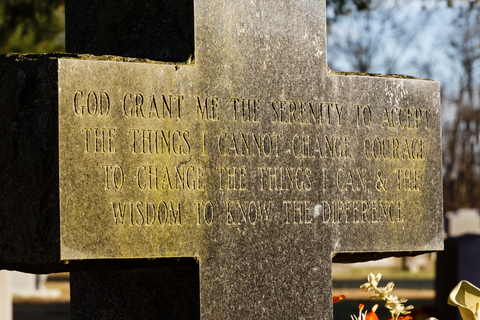
Serenity Prayer
Serenity Prayer

So in the particular case of animal abuse, my action is to not eat these beings and to speak about why I don’t when I can.

And since, like I said, most people don’t listen unless they already agree with me, I do what I can and accept what I can’t do (and pray for the wisdom to know the difference).

Constructive Anger

It’s natural to get angry when we experience mistreatment or disappointment, though how often and to what extent we feel anger varies. Some of us get extremely angry. Often. About many things. Others experience and express the emotion more moderately.

Chronic express of anger can be unhealthy and self-destructive. Not only does it cause physical reactions like rapid heartbeat, constriction of blood vessels and the release of hormones that can ruin our health over time, but we’re not likely to get what we want while immersed in anger. Why? First, it’s very difficult to make clear-headed decisions while we’re angry, and second, most people are put off by chronically angry people, so we won’t get the support that we need either.

Sure, this is easy for me to say. I’m more of the internalizing type, and I don’t express anger easily. And I know my way of dealing with anger has its own benefits and challenges.

Why are you angry?

Let’s say you’re angry because you didn’t win the lottery. Other people win the lottery, so why shouldn’t you? It’s not fair.

Is this kind of anger okay? Sure; why not? Is it useful? Probably not, unless it’s the only thing that motivates you to keep buying lottery tickets, and then you finally do win the lottery. (You’ll probably have a better experience in the meantime if you can keep buying those tickets with a clear and level head.)

Unfortunately, no amount of anger will cause you to pick a winning lottery ticket. Does this mean you should believe some higher force in the universe decides who gets to win the lottery and who doesn’t? I don’t think so. None of us fully understands how or why some people have great success and attract what they want and other people don’t.

Now before all of The Secret and Law of Attraction people jump all over this with that mantra that kind of blames the unfortunate for their own problems, let’s all stop for a moment and come a little bit back to the center.

If you have what you want, it’s probably because you have worked for it and you have believed in your ability to achieve or attract it, and you have been lucky.

I’m sorry if that rattles any feathers, but it’s the truth. It’s just plain wrong to suggest that some folks come up short on their dreams, however big or small those dreams, because they’re not trying hard enough. There is a thing called luck, and like control, it’s not always available when we’d like it or when we need.

It’s not all in your mind. But some of it is.

If you do enough soul-searching, you may find the “law of attraction” philosophies are largely based on fear of that we don’t all have as much control over all our circumstances as we’d like to have.

No, I am not a fatalist.  I do believe we have control over many things, possibly more things than we’re willing or able to admit. And it’s easy to get so lost in our negative emotions that we sabotage any chance we have for happiness or success of any kind.

I do believe that attitude plays a role (in fact, a huge role) in what we attract into our lives. But attitude alone won’t bring about positive change any more than anger alone will.

What is your anger telling you do to?

You can be angry as hell or perfectly aligned with the universe (in other words, on either end of the spectrum), but it won’t do you any good unless you know what you want and how to get it. Even so, I don’t believe everyone who is successful defined what they wanted and went for it. Sometimes people get lucky and are put in the path of things that are not hard to accept and be happy about!

Defining what you want and going for it is always a good idea, but getting attached to success (and either angry or down on yourself when things don’t work out) won’t help for more than fifteen minutes. Okay, take a whole day if you need to. Then take a deep breath and try again. And recognize that whether you fall again or not, you deserve to be happy.

It’s just too darned hard to be happy while you’re angry!

Self Love, Selflessness and Selfishness

The other day, a friend and I were kicking around the topic of self-love, a concept, we soon were reminded, That’s not simple. Most of us know we need to love ourselves and we could probably be a lot better at it.

So what is self-love? The definition is not so clear, perhaps because love is not easy to define.

Self love: Whose world is it anyway?

Along with the topic of self-love, my friend and I considered the idea of worldview. He pointed out that each person has a unique perspective, or worldview, that revolves around the person who holds that view. And so, he concluded, each person exists for himself. This was his take on the familiar idea of “looking out for number one.”

I didn’t agree that we all exist for ourselves. We do need to care for ourselves, but I don’t think we exist only for ourselves. We need to care about others, and not just because it’s a nice idea that sounds right, but because our own survival depends on our connection to those around us.

As is often the case when we let our initial reactions get in the way of true communication, I realized that, while I took issue with my friend’s statement about worldview, it was just one or two words before I could agree.

He seemed to be saying each person’s worldview revolves around that person and that the world as he or she knows it exists only in the mind of the observer. In other words, each person operates from a particular worldview, and the only world we can know is the one we ourselves observe.

But what if we learn to step back and widen our view, or at least acknowledge we are limited by our own view of things? We don’t each have our own world. We just have our own view of it. We are just a small part of the one world (or universe, if you prefer).

Love yourself

We do need to love ourselves in order to survive, and again, not just because it sounds nice and it’s the right thing to do. Think about how quickly you would be destroyed if you didn’t protect yourself from danger? Often, danger is concrete and obvious : the saber-toothed tiger, a madman with a gun, a hurricane, hunger, etc.

But what about being taken advantage of, put down, undervalued, criticized, or ignored? Those things are dangerous when they damage our self-esteem and threaten our ability to love ourselves. Subjected to such damage over time, we slowly die.

At first we may only suffer emotionally, but emotional damage often leads to physical illness. So it’s not hard to argue that we need to love and care for ourselves, and we need to do that before we can care for or love anyone else.

But do we also need to care for or love anyone else? I’m sure different people have different ideas about this, but I believe we cannot love ourselves without loving others as well. Because once we truly love ourselves, we recognize that we are part of a whole human experience. Once we truly love ourselves, we realize that we are love, and love cannot be contained.

Self love includes others

Many people put the needs of others ahead of their own, thinking this is the right thing to do. Selflessness is an admired quality, but not if it undervalues the person caring for others. In fact, true selflessness may be very damaging and dangerous.

I’m not talking about selfless acts, because there are times when it’s good, loving and noble, to put our own needs aside for a moment, or an afternoon, or a weekend, and let someone else come first. What is damaging is considering our own needs to always be secondary to the needs of others.

A healthy person is not selfless. He or she receives something in return for attending to the needs of others, and that’s how it should be. True selflessness would amount, in short, to death. So while we cannot love ourselves without loving others as well, and we also cannot love others until we love ourselves, we also cannot love only others or only ourselves.

There’s one world, and we’re ALL a part of it

Like it or not, we humans are interdependent. We need each other, but we need to choose our relationships wisely so we’re not exhausted or used up.

A lot of this choosing depends on our own personalities. Some people are more easily drained and need fewer relationships, while others thrive on interaction with others and need as much of it as possible. Neither is better than the other.

What we’re taught about ourselves and about caring for others also comes into play. Our personal histories influence how easily we’re able to make wise choices about the people we let into our lives.

In the end, each of us is the expert on our own needs, as well as our own ability and willingness to offer ourselves to others in a healthy way. Our bodies, our mind, and our spirits tell us when we’re doing a good job with ourselves and with others.

We also know when we have work to do on one end of the spectrum or the other. Like many things, it’s a question of balance, and the scales usually tip back and forth as we travel through our lives.

Previous Older Entries Next Newer Entries

Maria is a health and wellness writer and certified yoga instructor with a background in education, psychology, and nutrition. She has written hundreds of pages of content for clients in health-related fields, particularly those specializing in yoga, natural medicine, nutrition, psychology, and spiritual health and healing. She is also the author of "Yoga Circles, a Guide for Creating Community of the Mat." In addition to writing, Maria has worked as a nutritionist, teacher, and technical/nonfiction editor. To learn more about her writing, visit www.wellbeingwriter.net.