You Are What You Don’t Eat

You are what you don’t eat. And what you do eat. Or maybe you’re not food at all. So what, then, “are you” when it comes to nutrition and dietary choices?

Telling people I’m a vegetarian is the easiest way to explain why I don’t eat beef, pork, poultry, or lamb. But it doesn’t explain why I do eat fish (preferably wild-caught) and shellfish. It also doesn’t explain why I don’t eat sugar, refined carbohydrates or processed foods that contain ingredients I can’t pronounce. It doesn’t explain why I try to avoid the “dirty dozen” (the produce that absorbs the highest amounts of pesticides) or why, for me, a day without vegetables is like a day without water.

So what am I, and does it really matter? Personal dietary choices are something like religious beliefs in a way. Just because someone claims to be a member of a particular religion doesn’t mean that person has the same beliefs and behaviors as all the other members of the group.

Why labels don’t really matter

Religious labels do not tell the whole story, and neither do dietary labels. Still, people seem to want them. It helps to have some “rules” if you need to explain to someone why you choose not to eat turkey on Thanksgiving. You really can’t just say “turkey is not part of my diet” and get away with it, but you can say, “No thanks. I’m a vegetarian.”

It seems people expect a label with a definition attached to it, and then you are allowed to say no to the turkey. A case like that is a perfect example of “you are what you don’t eat.”

Dietary labels get complicated in some circles. It’s difficult to explain to your Italian mother that pasta is not something you eat now that your body is showing signs of carbohydrate intolerance. It took my mom a while to adjust when I stopped eating meat. Now this?

If I had to find a label for my diet, I guess it would be unprocessed/clean, real-food vegetarian that also eats some kinds of fish and drinks red wine and too much coffee. (By the way, did you know some vegans eat shellfish?)

But do you eat eggs?

Yes—cage free organic omega 3 eggs (unless I’m in a restaurant; then any egg goes). And, believe it or not, I really don’t like talking about any of this most of the time.

I know people imagine my dietary choices are restrictive or boring, but they’re really not. It’s true what they say; you stop craving things that are bad for you when you start eating healthier (and yummier) things instead. 

You don’t have to believe me, but there really are much tastier dishes you can make with veggies and lentils. Bacon grease or white bread are extremely dull to me!

Why all this fuss about food?

My interest in vegetarian nutrition started when I was in college looking to shed the “freshman 15” (more like 20). Soon after I graduated, I was diagnosed with hypoglycemia. I took an actual test though I know it was a fad diagnosis at the time.

I learned more about hormones and other unwanted things that accumulate in the fat of animal flesh. And I gradually made the shift to a vegetarian diet. As a DES daughter (one of millions whose mothers took this hormone during pregnancy between 1938 and 1971), I’d already overdosed on synthetic hormones before I was even born. (The consequences of that is another story.)

As I learned more about the things going on in the food industry, particularly with respect to factory farming, I became more and more convinced that the lower on the food chain one eats the better. It’s better not only for that person’s health, but for animals and the entire planet as well. Ethical reasons for my food choices soon became as important, if not more important, than health issues.

Then I realized how complicated that can get!

It took years to get where I am now, and I’m sure my dietary choices will continue to evolve. I even earned a traditional college degree in nutrition. I believe the important thing, whether you eat animal flesh or not, is to pay attention to how the food you choose affects you, the environment, and the world. There’s always something new to learn when it comes to nourishing not only our bodies, but everything around us as well.

And life is just better when you care!

Jack of all Trades; Master of a Few

A day in my life can pretty scattered, even in terms of writing career. It’s funny and wild at the same time. Luckily, I’m pretty good at multi-tasking!

A typical day will see me editing some technical reports about laser printers and other office devices. I navigate my way through the world of technology to load reports or calculate data that clarifies how one of these machines would run at a “slightly” different speed in Europe (where the standard paper sizes are different than those in the US).

After that, I might settle into some research and writing about nutrition, yoga, or cats for a writing client. I’ve written about subjects as diverse as marketing, insurance, wine, spa treatments and hypnosis. Then after a break for grocery shopping or yoga class, I start thinking about my personal writing — my blog or that book I’ve been trying to write.

Learning to Trust the Process

Most of the time I wonder what I’m doing. I wonder, but I don’t worry about it (anymore) because I’ve learned to trust the process.

I’ve had a few dreams that seem unrelated, but they connect in some way. There’s my writing, of course, my former lives as a nutritionist, a teacher and a psychology grad student, and my longstanding dream of operating a wellness center.

People would come to my wellness center mostly to do yoga and talk about truth and consciousness, but maybe also to learn about nutrition and other ways to improve their physical, mental and spiritual well-being.

I’ve had this dream for nearly 20 years, but so far the closest I’ve come is my own yoga practice and all the writing I do on related topics.

Going With the Flow and Trying Things Out

A friend of mine who is very much into the idea of going with the flow of life says the trick to understanding how the universe works and what we’re here for is to trust that we don’t need to know where we’re going. In fact, he says we don’t even need to know what we want (nice, if like him, you’re a successful artist and being a successful artist is what you have always wanted to be).

While I’m not necessarily comfortable with a “go with the flow” philosophy, I’ve mostly lived by one, simply because I don’t really have another choice.

Back in the day when I was still trying to figure out what kind of work I wanted to do, someone suggested I might not be finding work that was satisfying because I didn’t know what I wanted. Many new age gurus tell us to focus on our dreams and that we can create what we envision. But it always seemed more practical to me to just try out a bunch of things and see what I like (and what I don’t like).

Maybe this is just me. Like I said, what choice did have I had? You can’t force yourself to know what you want just because knowing is easier or more convenient.

At least I usually know what I don’t want!

Finding A Way That Works

And guess what I discovered? My way works too. There are lots of things I really like having in my life despite the fact that I didn’t necessarily know I wanted them. And there are lots of things I enjoy doing despite the fact that I didn’t necessarily set out to do them.

For example, I really do like crunching numbers for a while and then trotting off to clear my chakras!

Baseball Has Been Very, Very Good to Me

I was eight years old when my dad taught me how to read a box score. I was home sick from school and lounging on the sofa bed in the family room (which we called the “TV room”). With the newspaper between us, Dad explained to me what all the stats meant and even how to calculate some of them (he was a math teacher, after all).

Dad had grown up a Brooklyn Dodgers fan in the 1940s and 50s. I now know many stories about “dem bums.” When the Dodgers left Brooklyn, Dad stopped watching baseball – until his favorite player, Duke Snider, was traded to the New York Mets in 1963.

While Duke was only a Met for a year, Dad has remained a fan to this day. I don’t remember the miracle Mets of 1969, but I do remember the Amazing Mets of 1973. Baseball is one of the many ways my Dad and I have connected over the years. It would later become one of the ways my husband and I would connect.

It’s well-known that baseball is a metaphor for life; at least for the life of a diehard fan.

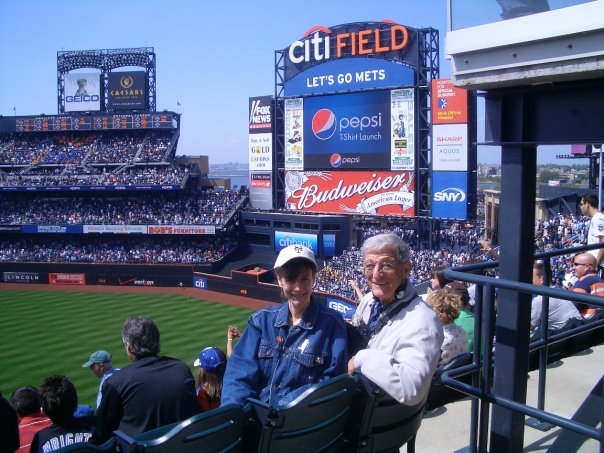
I went to my first game at Shea Stadium in 1975. My dad, my grandfather and I sat in the upper deck. It was batting helmet day, which meant kids got a plastic replica of that piece of players’ gear as a souvenir.

Over the years of my childhood, our whole family would go to at least one game a year – usually “banner day,” which in those days was a real double-header that only required a single ticket. My mom, who never really understood baseball, came along anyway. She’d pack a picnic cooler with sandwiches and fruit (usually peaches).

Met fan Ginger

Over the years of my youth, particularly my teenage years, baseball saved me more than once from bouts of existential angst. It always seemed like no matter what was worrying me, nothing could possibly go wrong while there was a baseball game on television.

This was even true in the late 1970s, when one of the things that usually did go wrong was that the Mets did not win the game! Still, there was a sense that baseball could bring peace to Earth.

There are other memories I associate with summer and baseball, too, like the smell of freshly cut grass, the image of a Rheingold beer can, and attempting to play the game myself with a bunch of friends at the park (I eventually traded in my glove for a tennis racket).

Even our dog was a Mets fan!

Over the years, I’ve been teased mercilessly by those other New York baseball fans (you know who you are). I don’t care much. They’re not the only ones who ever teased me, but at least in this case it was (mostly) good-natured fun.

As the fan of a team that goes years without winning, you learn some important life lessons winners perhaps don’t learn. For example, it’s not whether you win or lose but how much fun you have along the way that matters most.

When I went to college, my parents were thrilled that two of the guys I met the first week were “Italian Catholic Met fans.” What were the odds? While we were just friends, they are friendships I’ll always remember fondly.

And then came the ’86 Mets. I’ve seen clips of the end of Game 6—the turning point that led to the World Series win we’d waited 17 years to see—dozens of times in the decades since. It never gets old.

What I learned there is patience is a virtue and miracles can happen. Of course, it would be another 14 years before I’d see my team in a World Series again, but no matter. The time in between was still lots of fun.

In my thirties, I developed my own kind of meditation practice (in addition to the more traditional types). To calm my chattering mind, I’d watch a baseball game and tally the action on a scorecard. Focused only on that for a few hours, my worries would disappear, at least for a while.

The man I married was one of “those other” New York fans (despite the fact that he grew up in California). However, there is a happy ending — and a few more lessons — there. I learned tolerance in a whole new way. I also learned change for the better is possible. You see, while my husband does not like to admit it, he’s a convert. We’ve been to dozens of Mets games together over the years since!

First, though, I had to do the unthinkable. Two weeks after our first date (a visit to the Yogi Berra Museum in Montclair, NJ), he took me to Baltimore to see the Orioles play the Yankees.

As if that wasn’t enough to cause my father serious concern, the next season I went to the one place where Dad never thought he’d see me go. Yes, I went to Yankee Stadium. (Love makes you do strange things.) For my Mets fan friends who don’t know about this part of my past, I’m sorry you had to find out this way!

Wrigley stands

Soon after, though, my husband discovered what I’d known all along. The New York Mets are much more fun to watch! So we set out to see them—or any team—play all over the country.

We took a seven hour drive to Pittsburgh when the Mets played there. There were a few trips to Philadelphia, one to Milwaukee, and (my favorite) to Chicago’s Wrigley Field. And in 2006, we took the first of three trips to Florida for my birthday (which happens be during spring training).

There’s nothing quite as uplifting as leaving winter behind and watching your team prepare for opening day. We wove stops at baseball stadiums into our Arizona and San Francisco vacations as well, though the Mets were not in town in either place at the time.

At one point we planned to get to every ballpark in the country. I don’t know if we’ll ever meet that goal, but you know what they say. The journey is more important than the destination.

Now, it may seem at first glance that a post about baseball is out of place on a blog about “wellness and vibrating at higher frequencies.” But if you’re a baseball fan too, you know why it’s here. After decades of watching the game and rooting for my (often underdog) team, it has not gotten old.

It has gotten harder though (maybe much like life itself). As a kid, all I saw was a game. Now I see greed, steroids and other unseemly things that are often hard to overlook. But the joy of the game trumps all that. As all fans know, baseball is a lot like life. It can be the best thing in the world if you’re willing to accept its flaws and stay focused on the things that make it great.

Time Travel and The Reality of Now

I’ve been wondering lately if there’s really such a thing as time. I say this because, for one thing, I realize it’s now, just like it’s always been. But more significantly, I’ve recently done some time traveling. Not the kind you see in the movies but the kind you do in your mind.

You see, my mom gave me the journal she kept when my siblings and I were kids. She thought it would be a great idea if I typed it up “for posterity” (we’ve always had trouble reading Mom’s handwriting; she can’t always read it herself).

I agreed to this task, though I thought it would take me to get through her writings. It took only a few days (hours really).

Moving Through Time

The time travel started in the late sixties, with the first comments she made about my sister and me (then toddlers). By the time I finished typing, I had reached the end of my first year of college. But all along the way, I was right there in whatever year I was transcribing on.

I relived things I don’t remember, like my first words, the day my little brother was brought home from the hospital, and the time my sister locked our Mom out of the house when she went outside to throw out the trash!

I also relived things I do remember, like waiting for days for my cat to come home after he’d wandered off (more than once), going to middle school, getting my driver’s license, and the ear infection that led me to lose most of the hearing in my right ear.

For days after typing these “notes,” I felt as if I had never left my childhood home. I felt like my parents were still in their forties and my grandparents were still on Earth.

At the same time, I felt like I was still an adolescent and a young adult. Then I got the idea of adding old pictures to the document, and the time travel became even more intense.

I had a similar experience with time travel when I joined began reconnecting with people from grade school, high school, college, past jobs, and recent yoga classes on social media. It was if it was simultaneously 1970, 1978, 1985, 1995 and 2007. Weird. Really.

Time is How the Universe Watches Itself Unravel

I do wonder about the significance of time. Physicists say time is a measure of entropy. That is, it’s basically watching how messed up things get as it goes on. Apparently, at the beginning of time, things were not as messy as they are now.

According to physicist Sean Carroll, time works much differently at the microscopic level. At that level, there apparently is no “arrow of time,” meaning time is no longer linear.

“If you do believe that the fundamental laws of physics are reversible then what you believe really is that information is conserved. So if you knew everything about the universe at one precise moment in time, in principle, you could turn a little crank and predict what the future would be like and reconstruct what the past would be like,” Carroll says.

At Some Point, We No Longer Need Time

No, I don’t really understand that, but it supposedly means if we knew everything about ourselves and the universe, there would no longer be “free will.” In other words, you could say if you knew everything about yourself and the universe, you would be God or creation or whatever it is you are currently unable to understand. And in that case, free will would no longer be necessary.

The reality of time (and no time) is a lot to wrap our heads around, which is probably why we don’t. We’ll probably never know enough to see the future and we never be able to reconstruct the past — unless we read our mothers’ journals or join old friends on social media.

Do What You Want (as long as you don’t hurt anyone)

Recently, I had a conversation with a friend who suggested a good motto to live by is “Do what you want, as long as you don’t hurt anyone.”

On the surface, this seems like great advice. But something about it didn’t seem quite right to me, and I found myself thinking about it more. The question nagging me was this: Is it really possible to always do what we want without ever hurting anyone?

I finally decided the answer to my nagging question depends on what’s meant by “what I want.” The phrase what I want seems to disregard anyone other than me. Of course this isn’t always the case, and I know it’s not what my friend meant when he shared his motto.

As it happened, soon after that conversation, as I was mulling over this idea of doing what I want (without hurting anybody), I picked up a book I was reading called “Awaken,” by Reverend Jaganath Carrera. And there, right on page 94, the very page where my bookmark was saving my place, was this quote:

The beneficial is one thing; the pleasant is another. These two, differing in their ends, both prompt to action. Blessed are they that choose the beneficial; they that choose the pleasant miss the goal.” ~Katha Upanishad

In the book, Reverend Carrera goes on to explain that when we do something pleasurable in the moment without regard to whether or not it is beneficial, there is no lasting value to that action for ourselves or for anyone else. “Beneficial acts improve someone’s material security, physical and psychological well-being, and advance spiritual growth,” he says.

We’re all connected, and our actions affect each other

Personally, I think the only way to live and “do what you want as long as you don’t hurt anyone” is if you have no relationship with others or with the planet in general for that matter. A more valuable and enriching philosophy, I think, is to make choices that are beneficial (including—maybe even especially including—those that are pleasurable).

Perhaps the most important person to consider when weighing whether or not an action is beneficial is not other people (though they should be included), but you.

I’m no authority on anything, but I do think we should do things that help us grow physically, mentally, emotionally, and spiritually. That doesn’t mean they can’t be enjoyable; enjoyment of life is part of overall well-being.

The problem is if our goal is simply to “not hurt others,” the goal has little value and (I believe) is almost impossible to reach. The reason is it’s often not obvious when our choices, pleasant and innocent as they may seem, hurt others—and ourselves—in the long run.

Try to think of something you can do that doesn’t affect anyone, either positively or negatively. There’s really nothing. As human beings, like it or not, we are all connected, and in some way, everything we do affects at least one other person.

So let’s just say for argument’s sake that what people mean when they say, “I’m not hurting anyone” is “I’m not hurting anyone that I’m aware of at the moment.” And just to cover all bases, let’s also say “I’m not helping anyone” means “I’m not helping anyone that I’m aware of at the moment.”

The only way the philosophy of doing what you want as long as you don’t hurt anyone works as a general way of life is if no one cares about you. It’s highly unlikely that no one cares about you. It is possible you don’t believe anyone cares about you or that you don’t feel cared for. If that’s the case, it’s easier to understand why you would think you can do what you want.

Do What You Want as Long as It’s Beneficial

A better idea (I think) is to do what you want as long as it is beneficial. And remember that you can be the one who benefits.

Think about the things you would like to do that you don’t think will hurt anyone. Are those actions hurting you? Are you sure? They are hurting you if they are not adding something truly positive to your life.

The benefit has to outweigh, or at least be equal to, the pleasure. Notice the pleasure is still there. (Yes, there are times we need to do things that aren’t pleasant because they are beneficial, but those are not the things I’m talking about.)

Does it feel good to eat a cheeseburger and drink a six pack of beer when you are alone and there is no one around who notices or cares about whether or not that’s good for you? Perhaps, but what’s the benefit?

And here’s another wrinkle. I think there are times when our actions do hurt someone, but it’s still the right (more beneficial) choice. For example, if you’re the type whose friends rely on you to validate, support, and help them with all kinds of problems, no matter what the time of day or night or how realistic their expectations might be, you may need to consider how beneficial your “help” really is.

A friend may feel hurt or offended when you don’t come through or when you choose to do something for yourself instead. Is it beneficial to continue to play the role of “good friend” at any cost? In a case like this, it may be better to do what you want even though it hurts someone else.

I think deep down we would all like to spend our lives growing, which brings me back to the quote I mentioned a few paragraphs back. It’s a really great quote, and so here it is again:

The beneficial is one thing; the pleasant is another. These two, differing in their ends, both prompt to action. Blessed are they that choose the beneficial; they that choose the pleasant miss the goal. ~Katha Upanishad

Next Newer Entries

Maria is a health and wellness writer and certified yoga instructor with a background in education, psychology, and nutrition. She has written hundreds of pages of content for clients in health-related fields, particularly those specializing in yoga, natural medicine, nutrition, psychology, and spiritual health and healing. She is also the author of "Yoga Circles, a Guide for Creating Community of the Mat." In addition to writing, Maria has worked as a nutritionist, teacher, and technical/nonfiction editor. To learn more about her writing, visit www.wellbeingwriter.net.